- The Simplest Income Tax Calculation For A Single Person Filing Federal Income Taxes In The United States Involves Applyi 1 (38.36 KiB) Viewed 19 times
if Taxable_Income >= 0.01 && Taxable_Income <= 9225.00 TotalTax = 0.1*Taxable_Income; EffectiveTaxRate = TotalTax/Income;It's my code. Is this worng?
if Taxable_Income >= 0.01 && Taxable_Income <= 9225.00
TotalTax = 0.1*Taxable_Income;
EffectiveTaxRate = TotalTax/Income;
It's my code. Is this worng?
How can I fix it?
- The Simplest Income Tax Calculation For A Single Person Filing Federal Income Taxes In The United States Involves Applyi 2 (31.71 KiB) Viewed 19 times
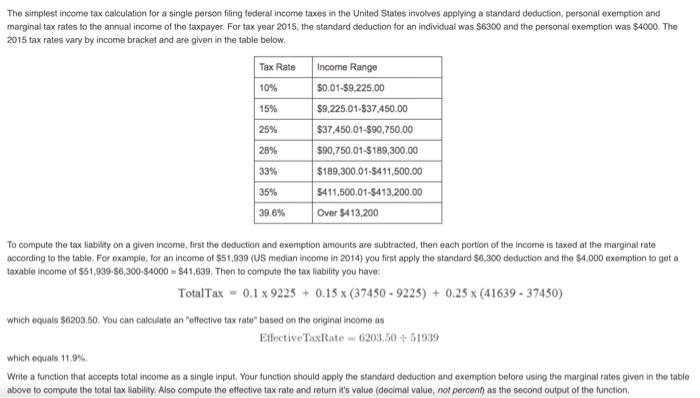
The simplest income tax calculation for a single person filing federal income taxes in the United States involves applying a standard deduetion, personal exemption and marginal tax rates to the annual income of the taxpayer. For tax year 2015 , the standard deduction for an individual was $6300 and the personal exemption was $4000. The 2015 tax rates vary by income bracket and are given in the table below. To compute the tax liabiaty on a given income, first the deduction and exemption amounts are subtracted, then each portion of the income is taxed at the marginal rate according to the table. For example, for an income of $51,939 (US median income in 2014 ) you first apply the standard $6.300 deduction and the $4,000 exemption to get a taxable income of $51,939⋅$6,300−$4000=$41,639. Then to compute the tax liability you have: TotalTax =0.1×9225+0.15×(37450−9225)+0.25×(41639−37450) which eesals $6203.50. You can calculate an "effective tax rate" based on the original income as Effective Taxifate =6203.50÷51939 which equale 11.9%. Write a function that aocepts total income as a single input. Your function should apply the standard deduction and exemption before using the marginal rates given in the table above to compute the total tax kiability. Also compute the effective tax rate and return it's value (decimal value, not percent) as the second output of the function.
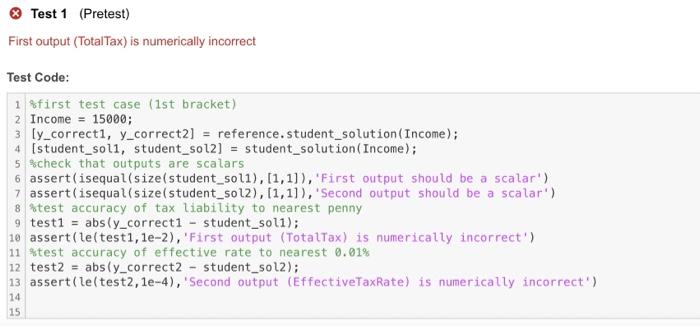
凶) Test 1 (Pretest) First output (TotalTax) is numerically incorrect Test Code: 1 sfirst test case (1st bracket) 2 Income = 15000; 3 [y_correct1, y_correct2] = reference.student_solution(Income); 4 [student_sol1, student_sol2] = student_solution(Income); 5 scheck that outputs are scalars 6 assert(isequal(size(student_sol1), [1,1]), 'First output should be a scalar') 7 assert(isequal(size(student_sol2), [1,1]),'Second output should be a scalar') 8 stest accuracy of tax liability to nearest penny 9 test1 = abs(y_correct1 - student_sol1); 10 assert(le(test1, 1e-2),'First output (TotalTax) is numerically incorrect') 11 stest accuracy of effective rate to nearest 0.019 12 test2 = abs(y_correct2 - student_sol2); 13 assert(le(test2, 1e-4),' 'Second output (EffectiveTaxRate) is numerically incorrect')