- 2 Example 3 Analytically Determined Statistics For An Rv Constant In Time Sample Functions X Si Z Where Z Changes 1 (51.18 KiB) Viewed 67 times
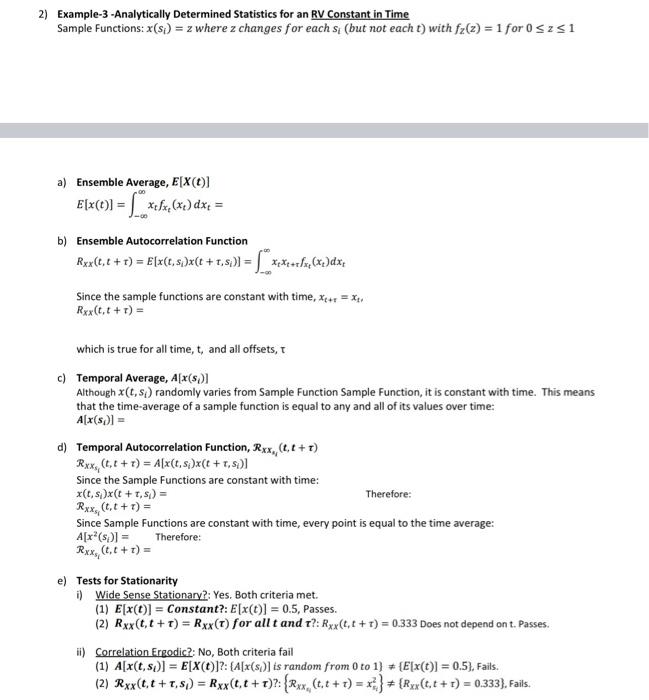
2) Example-3 -Analytically Determined Statistics for an RV Constant in Time Sample Functions: x(si) = z where z changes for each s (but not each t) with fz(z) = 1 for 0 Szsi a) Ensemble Average, E[X()) E[X(t)) = xfx, (x2) dx = x(0= $8 b) Ensemble Autocorrelation Function Rxx(t.e + 7) = E[xce.si)x(8 + 1,5) = 1 *ief, adx, Since the sample functions are constant with time, Xe+u = Xx Rxx(t.t + 1) = which is true for all time, t, and all offsets, c) Temporal Average, A[x(s)] Although X(t,s) randomly varies from Sample Function Sample Function, it is constant with time. This means that the time-average of a sample function is equal to any and all of its values over time: A[x(s.] = d) Temporal Autocorrelation Function, Rxx, (t,t + ) Rxx, (1,2 + ) = A[x(t, s.)x(t + 1,50)] Since the Sample Functions are constant with time: x(t.s)x(t + 1,5) = Therefore: Rxx, (t.t + 1) = Since Sample Functions are constant with time, every point is equal to the time average: A[x ($) Therefore: Rxx, (t.1 + 1) = e) Tests for Stationarity i) Wide Sense Stationary?: Yes. Both criteria met. (1) E[X(t)] = Constant?: E[X(t)) = 0.5, Passes. (2) Rxx(t.t + 7) = Rxx() for all t and T?: Rxx(t,t + 1) = 0.333 Does not depend on t. Passes. ii) Correlation Ergodic?: No, Both criteria fail (1) A[x(t. $0] = E[X(t)]?: {A[x(s)] is random from 0 to 1} + {E[x()) = 0.5). Fails. (2) Rxx(t.t+1,5) = Rxx(t.t + 1)2:{Rex, (t.t + 1) ==}} + {Rxx(t.t + 1) = 0.333), Fails.