- After Reading The Following Document About Bacteria Transformation Propose A New Idea For The Laboratory These Have To 1 (109.23 KiB) Viewed 56 times
- After Reading The Following Document About Bacteria Transformation Propose A New Idea For The Laboratory These Have To 2 (61.74 KiB) Viewed 56 times
- After Reading The Following Document About Bacteria Transformation Propose A New Idea For The Laboratory These Have To 3 (65.08 KiB) Viewed 56 times
After reading the following document about bacteria transformation, propose a new idea for the laboratory. These have to help replicate the learning acquired for the chosen topics. In each of the designs, remember to mention objective/s, rationale, materials, procedure/s, among other things that may facilitate the execution of the experiment for possible future activities. You can include videos, links, games, among other resources that put the concepts of the class material into practice. At this point you can create preparation guides for the possible data that may be taken (see example of previous works), Creativity and originality will be evaluated. Transformation of bacteria . . Goals: Correlate the function of DNA and the phenotype of the organism • Identify and explain the applications of the transformation of bacteria in medicine, agriculture and other industries • Define: vectors, plasmids, restriction enzymes, restriction sites, DNA ligase and transformation, biotechnology • Practice aseptic technique, streaking, handling of microorganisms, and use of micropipettes • Carry out the transformation of bacteria using a plasmid • Determine the efficiency of the transformation . . I Introduction: In 1928, experiments by Frederick Griffith provided some of the first evidence that DNA is the genetic material. This evidence is based on the transformation process, which involves the ability of bacteria to acquire segments of genetic material from the environment and express them. At present, the ability of bacteria to be transformed is used to manipulate and express genes from different organisms in order to provide benefits in medicine, agriculture and the environment, among others. This is what biotechnology is about, the application of biological principles, organisms and products for practical purposes. Plasmids are small pieces of circular DNA that exist in the cytoplasm of bacteria. This extrachromosomal genetic material has the ability to enter, replicate and express itself in bacteria. Scientists from multiple disciplines use these plasmids as vectors (loaders) containing a gene of interest to facilitate transmission and expression of that particular gene in bacteria. The process by which these vectors are introduced to bacteria is the transformation process. In the laboratory, transformation is induced by a dramatic change in temperature ("heat-shock") that permeabilizes the bacterial cell wall. Once transformation has occurred, both the plasmid DNA and the expression products of the genes in the plasmid can be obtained. Construction of recombinant DNA molecules (i.e., plasmid + gene of interest) is possible using two types of naturally occurring enzymes, restriction enzymes and DNA ligase. Restriction enzymes are enzymes that catalyze the hydrolysis of phosphodiester bonds between DNA nucleotides in specific sequences or regions (sites of Appendix 3 restriction). The plasmids used as vectors have a region that contains multiple restriction sites ("Relylinker") to facilitate the insertion of the gene of interest (see figure 1). DNA ligase is the same that is part of the replication machinery catalyzing the formation of phosphodiester bonds between nucleotides
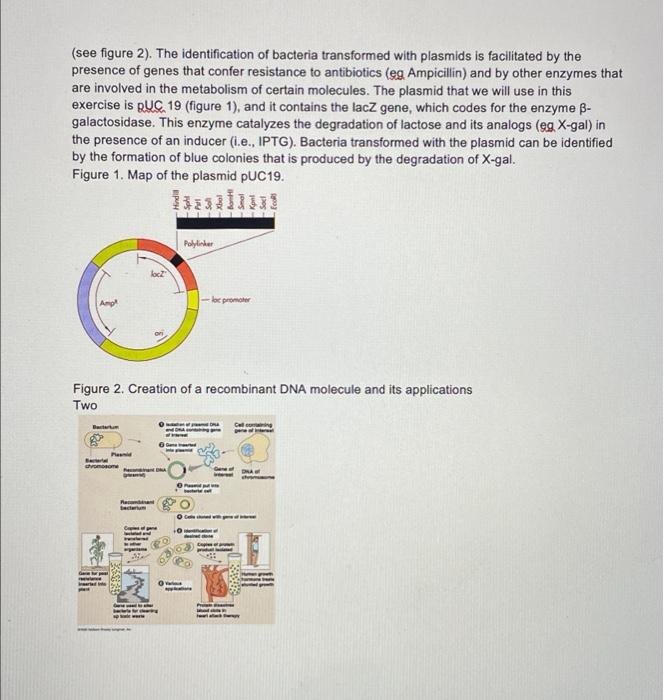
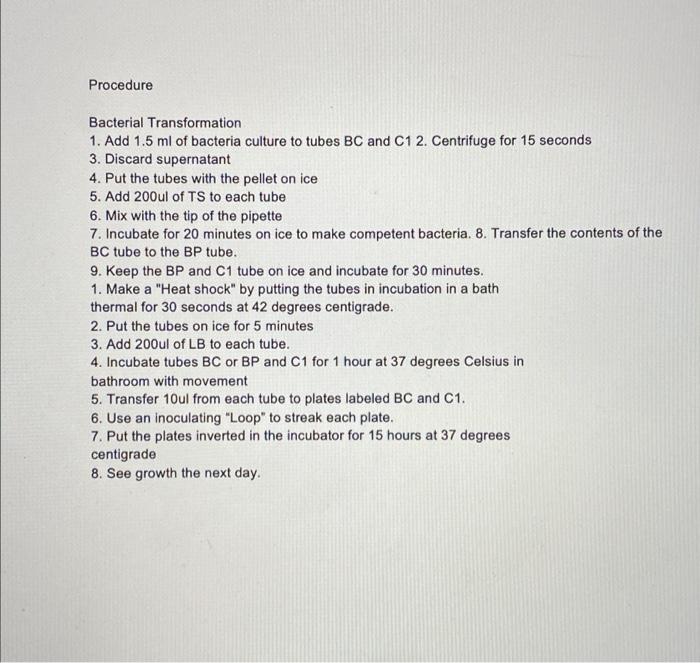
(see figure 2). The identification of bacteria transformed with plasmids is facilitated by the presence of genes that confer resistance to antibiotics (eg Ampicillin) and by other enzymes that are involved in the metabolism of certain molecules. The plasmid that we will use in this exercise is QUC. 19 (figure 1), and it contains the lacZ gene, which codes for the enzyme B- galactosidase. This enzyme catalyzes the degradation of lactose and its analogs (eg, X-gal) in the presence of an inducer (i.e., IPTG). Bacteria transformed with the plasmid can be identified by the formation of blue colonies that is produced by the degradation of X-gal. Figure 1. Map of the plasmid PUC 19. Hindi Sphil 1- SOA Xbol BHI Smol Kpel Eco Polylinker loc -- boc promoter Figure 2. Creation of a recombinant DNA molecule and its applications Two Bm Med மானாம் Recom -
Procedure Bacterial Transformation 1. Add 1.5 ml of bacteria culture to tubes BC and C1 2. Centrifuge for 15 seconds 3. Discard supernatant 4. Put the tubes with the pellet on ice 5. Add 200ul of TS to each tube 6. Mix with the tip of the pipette 7. Incubate for 20 minutes on ice to make competent bacteria. 8. Transfer the contents of the BC tube to the BP tube. 9. Keep the BP and C1 tube on ice and incubate for 30 minutes. 1. Make a "Heat shock" by putting the tubes in incubation in a bath thermal for 30 seconds at 42 degrees centigrade. 2. Put the tubes on ice for 5 minutes 3. Add 200ul of LB to each tube. 4. Incubate tubes BC or BP and C1 for 1 hour at 37 degrees Celsius in bathroom with movement 5. Transfer 10ul from each tube to plates labeled BC and C1. 6. Use an inoculating "Loop" to streak each plate. 7. Put the plates inverted in the incubator for 15 hours at 37 degrees centigrade 8. See growth the next day.