Page 1 of 1
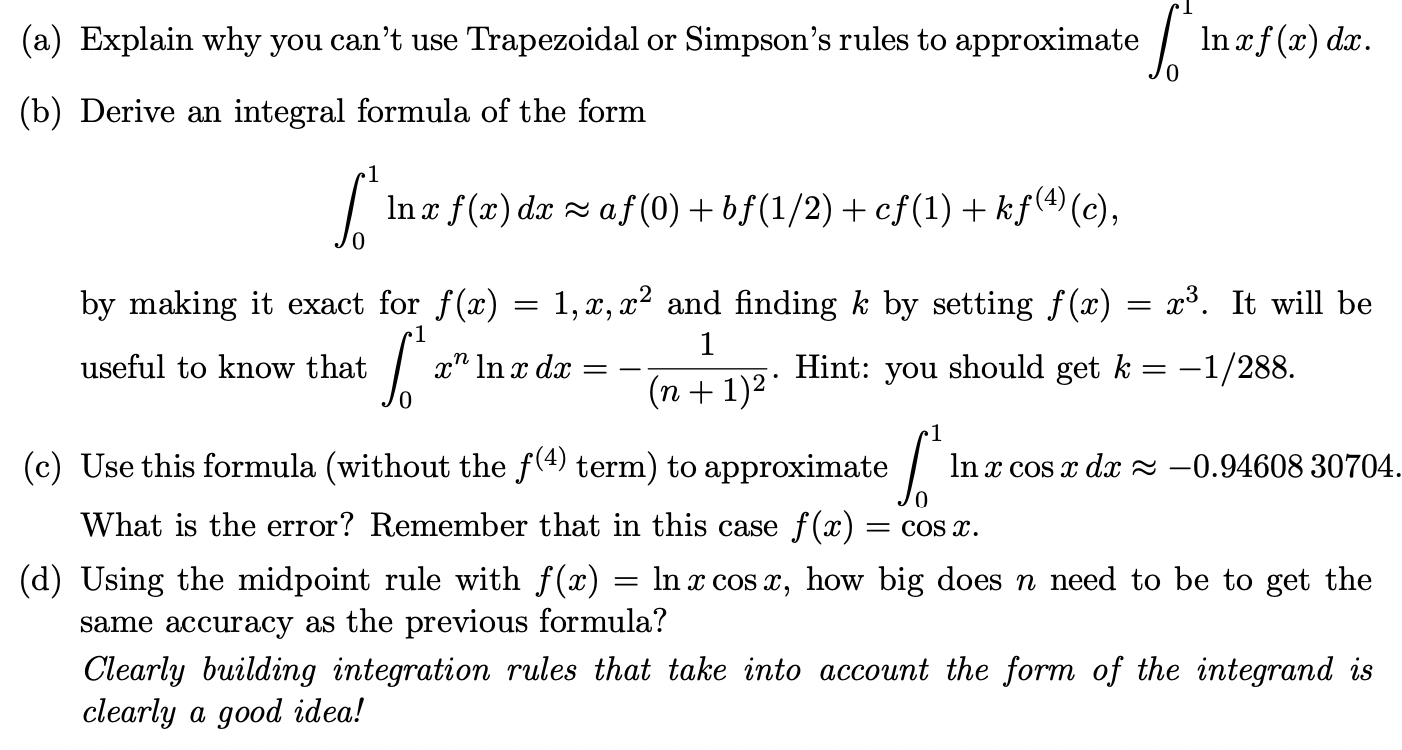
(a) Explain why you can't use Trapezoidal or Simpson's rules to approximate / In af() dx. (b) Derive an integral formula
Posted: Tue May 10, 2022 7:44 am
by answerhappygod
- A Explain Why You Can T Use Trapezoidal Or Simpson S Rules To Approximate In Af Dx B Derive An Integral Formula 1 (323.48 KiB) Viewed 33 times
(a) Explain why you can't use Trapezoidal or Simpson's rules to approximate / In af() dx. (b) Derive an integral formula of the form 1 ti In x f(x) dx ~af (0) +bf(1/2) + cf(1) +kf(4)(c), = = X3. It will be 1 by making it exact for f(x) = 1, x, x2 and finding k by setting f(2) 1 useful to know that x” In x dx Hint: you should get k (n + 1)2 [ - = -1/288. = = (c) Use this formula (without the f(4) term) to approximate In x cos x dx = -0.94608 30704. What is the error? Remember that in this case f(x) = cos x. (d) Using the midpoint rule with f(x) In x cos x, how big does n need to be to get the same accuracy as the previous formula? Clearly building integration rules that take into account the form of the integrand is clearly a good idea!