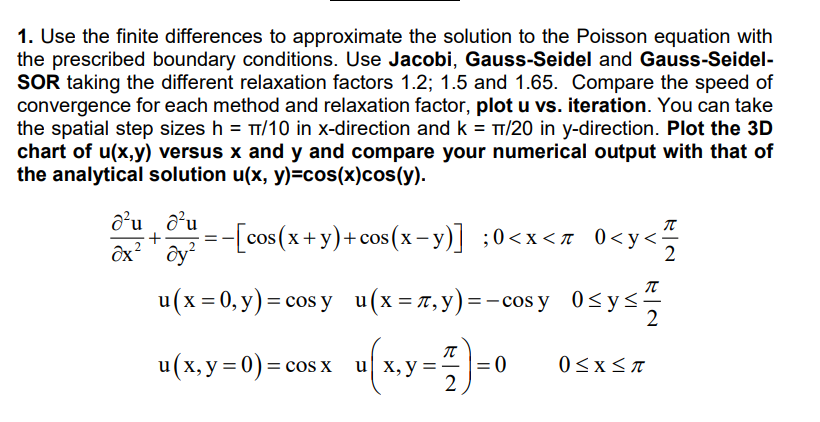
Use the finite differences to approximate the solution to the
Poisson equation with the prescribed boundary conditions. Use
Jacobi, Gauss-Seidel and Gauss-Seidel-SOR taking the different
relaxation factors 1.2; 1.5 and 1.65. Compare the speed of
convergence for each method and relaxation factor, plot u vs.
iteration. You can take the spatial step sizes h = π/10 in
x-direction and k = π/20 in y-direction. Plot the 3D chart of
u(x,y) versus x and y and compare your numerical output with that
of the analytical solution u(x, y)=cos(x)cos(y).
- Use The Finite Differences To Approximate The Solution To The Poisson Equation With The Prescribed Boundary Conditions 1 (98.69 KiB) Viewed 23 times
1. Use the finite differences to approximate the solution to the Poisson equation with the prescribed boundary conditions. Use Jacobi, Gauss-Seidel and Gauss-Seidel- SOR taking the different relaxation factors 1.2; 1.5 and 1.65. Compare the speed of convergence for each method and relaxation factor, plot u vs. iteration. You can take the spatial step sizes h = Tt/10 in x-direction and k = 1/20 in y-direction. Plot the 3D chart of u(x,y) versus x and y and compare your numerical output with that of the analytical solution u(x, y)=cos(x)cos(y). au du ht = + Ox? @y? 2 --[cos(x+y)+cos(x –y)] ;0<x<t 0<y< + u(x = 0, y) = cos y u(x=r,y)=-cosy Osys u(x, y =0) = cos x u(x,x=)- y0 y 2 л = y = 0 0<x<n 2