- B Since The Cilia Are In The Same Fluid Assume That The Damping Coefficient Always Satisfies C 0 1 If The Test Soun 1 (132.94 KiB) Viewed 39 times
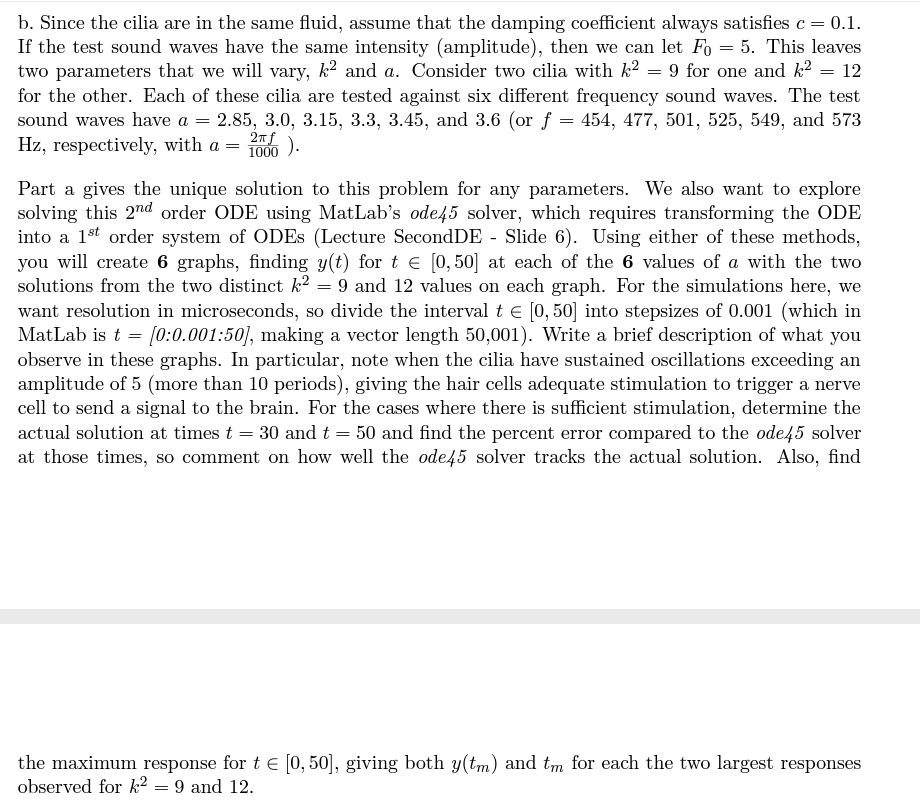
b. Since the cilia are in the same fluid, assume that the damping coefficient always satisfies c = 0.1. If the test sound waves have the same intensity (amplitude), then we can let Fo= 5. This leaves two parameters that we will vary, k² and a. Consider two cilia with k² = 9 for one and k² = 12 for the other. Each of these cilia are tested against six different frequency sound waves. The test sound waves have a = 2.85, 3.0, 3.15, 3.3, 3.45, and 3.6 (or f = 454, 477, 501, 525, 549, and 573 Hz, respectively, with a = 100). ·). f Part a gives the unique solution to this problem for any parameters. We also want to explore solving this 2nd order ODE using MatLab's ode45 solver, which requires transforming the ODE into a 1st order system of ODEs (Lecture SecondDE - Slide 6). Using either of these methods, you will create 6 graphs, finding y(t) for t = [0,50] at each of the 6 values of a with the two solutions from the two distinct k² = 9 and 12 values on each graph. For the simulations here, we want resolution in microseconds, so divide the interval t € [0,50] into stepsizes of 0.001 (which in MatLab is t = [0:0.001:50], making a vector length 50,001). Write a brief description of what you observe in these graphs. In particular, note when the cilia have sustained oscillations exceeding an amplitude of 5 (more than 10 periods), giving the hair cells adequate stimulation to trigger a nerve cell to send a signal to the brain. For the cases where there is sufficient stimulation, determine the actual solution at times t = 30 and t = 50 and find the percent error compared to the ode45 solver at those times, so comment on how well the ode45 solver tracks the actual solution. Also, find the maximum response for t€ [0,50], giving both y(tm) and tm for each the two largest responses observed for k² = 9 and 12.
c. The particular solution consists of only a sine and cosine function, and the amplitude of this function is readily obtained (2DLinSysAppl - Slide 31), giving the maximum response for any of the parameters in (1). In this part of the problem, we want to observe the maximum response for distinct cilia with k² = 8, 9, 10, 11, 12, and 13 over a continuous range of sound frequencies, a € [2.7,3.8]. We want to display this result in a 3D graph of the amplitude vs the values of k² and a. The peaks will show the sound wave frequencies that most stimulate a particular hair cell. Compare the maximal response for k² = 9 and 12 with a = 3.0 and 3.45 to the numerical values in Part b.