- Determine The X Components Of The Forces On The Proton Express Your Answers In Terms Of Some Or All Of The Values K 9 1 (156.13 KiB) Viewed 46 times
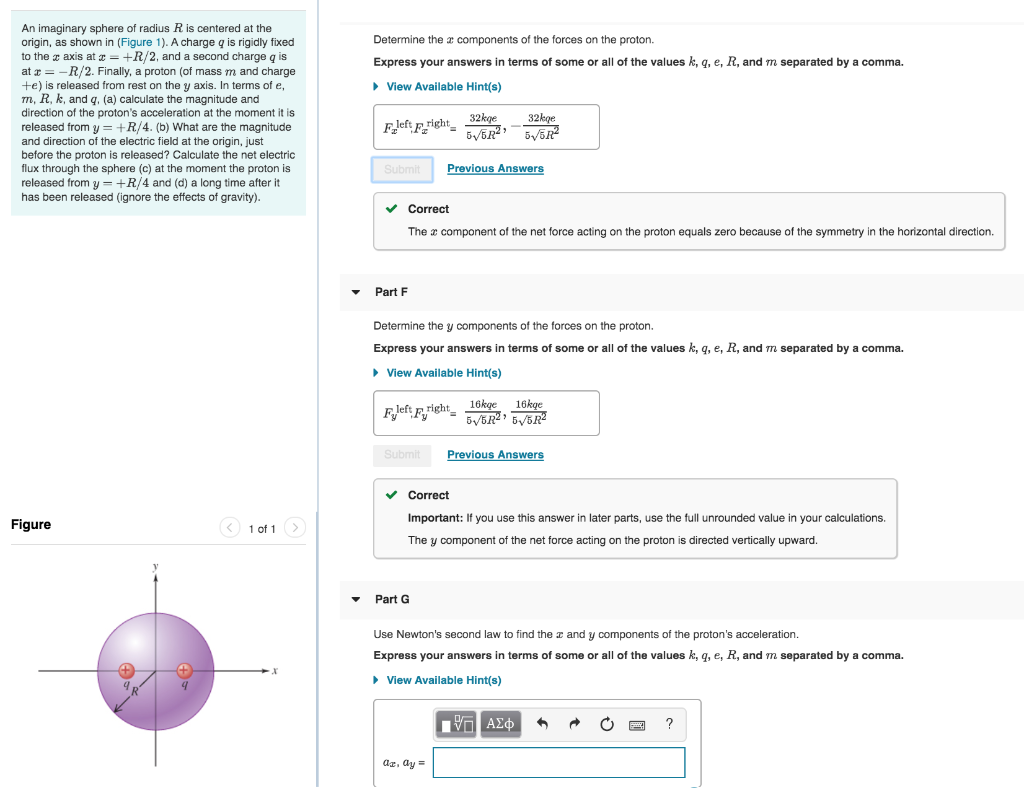
Determine the x components of the forces on the proton. Express your answers in terms of some or all of the values k, 9, e, R, and m separated by a comma. View Available Hint(s) An imaginary sphere of radius R is centered at the origin, as shown in (Figure 1). A charge q is rigidly fixed to the x axis at <= +R/2, and a second charge q is at x = -R/2. Finally, a proton (of mass m and charge te) is released from rest on the y axis. In terms of e, m, R, K, and q. (a) calculate the magnitude and direction of the proton's acceleration at the moment it is released from y= +R/4. (b) What are the magnitude and direction of the electric field at the origin, just before the proton is released? Calculate the net electric flux through the sphere (c) at the moment the proton is released from y = +R/4 and (d) a long time after it has been released (ignore the effects of gravity). Fzleft right 32kge = 5/6R2) Submit Previous Answers Correct The x component of the net force acting on the proton equals zero because of the symmetry in the horizontal direction. Part F Determine the y components of the forces on the proton. Express your answers in terms of some or all of the values k, q, e, R, and m separated by a comma. View Available Hint(s) right 16kye 16kqe F left Fyright5/GRY 675R Submit Previous Answers Correct Figure < 1 of 1 Important: If you use this answer in later parts, use the full unrounded value in your calculations The y component of the net force acting on the proton is directed vertically upward. Part G Use Newton's second law to find the and y components of the proton's acceleration. Express your answers in terms of some or all of the values k, q, e, R, and m separated by a comma. ► View Available Hint(s) V AED PO 2 ?
Part 1 Find the components of the electric field at the origin using vector addition just before the proton is released. An imaginary sphere of radius R is centered at the origin, as shown in (Figure 1). A charge q is rigidly fixed to the x axis at < = +R/2, and a second charge q is at x = -R/2. Finally, a proton (of mass m and charge te) is released from rest on the y axis. In terms of e, m, R, k, and q, (a) calculate the magnitude and direction of the proton's acceleration at the moment it is released from y=+R/4. (b) What are the magnitude and direction of the electric field at the origin, just before the proton is released? Calculate the net electric flux through the sphere (c) at the moment the proton is released from y = +R/4 and (d) a long time after it has been released (ignore the effects of gravity). Express your answers in terms of some or all of the values k, q, e, R, and m separated by a comma. ► View Available Hint(s) IV AXO O P ? Egrigin Egrigin Submit Part 1 Use Gauss's law to calculate the final flux through the sphere, after the proton has moved a significant distance. Express your answers in terms of some or all of the values k, q, e, R, and m. ► View Available Hint(s) V ADO A 0 2 ? Efinals Submit Figure 1 of 1 >