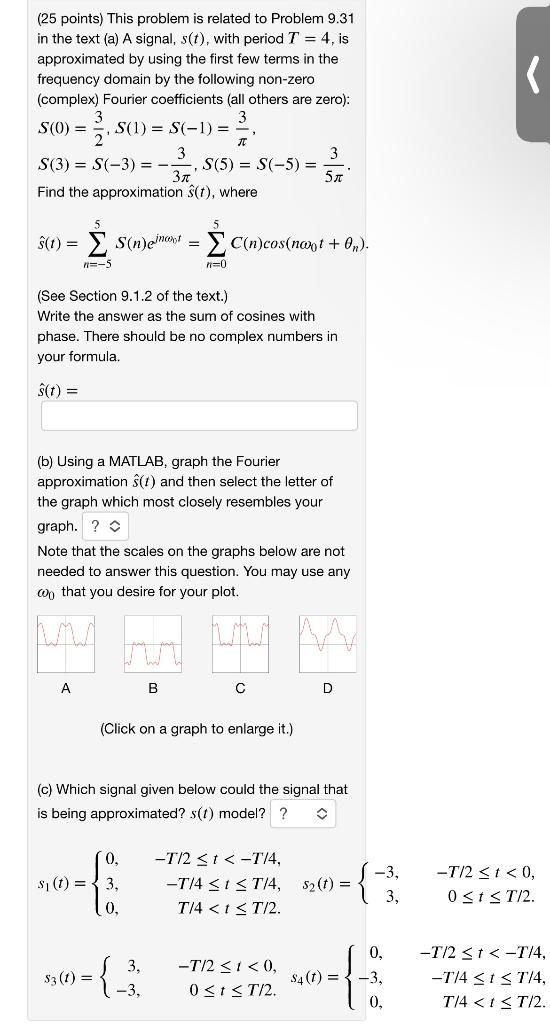
This problem is related to Problem 9.31 in the text (a) A
signal, s(t)s(t), with period T=4T=4, is approximated by
using the first few terms in the frequency domain by the following
non-zero (complex) Fourier coefficients (all others are
zero): S(0)=32S(0)=32, S(1)=S(−1)=3πS(1)=S(−1)=3π, S(3)=S(−3)=−33πS(3)=S(−3)=−33π, S(5)=S(−5)=35πS(5)=S(−5)=35π.
Find the approximation s^(t)s^(t), where
s^(t)=∑n=−55S(n)ejnω0t=∑n=05C(n)cos(nω0t+θn).s^(t)=∑n=−55S(n)ejnω0t=∑n=05C(n)cos(nω0t+θn).
(See Section 9.1.2 of the text.)
Write the answer as the sum of cosines with phase. There should be
no complex numbers in your formula.
s^(t)=s^(t)=
(b) Using a MATLAB, graph the Fourier
approximation s^(t)s^(t) and then select the letter of
the graph which most closely resembles your
graph. ? A B C D
Note that the scales on the graphs below are not needed to answer
this question. You may use any ω0ω0 that you desire for
your plot.
(Click on a graph to enlarge it.)
(c) Which signal given below could the signal that is being
approximated? s(t)s(t) model? ? s1(t) s2(t) s3(t) s4(t)
- This Problem Is Related To Problem 9 31 In The Text A A Signal S T S T With Period T 4t 4 Is Approximated By Using 1 (76.88 KiB) Viewed 40 times
(25 points) This problem is related to Problem 9.31 in the text (a) A signal, s(t), with period T = 4, is approximated by using the first few terms in the frequency domain by the following non-zero (complex) Fourier coefficients (all others are zero): S(0) = S(1) = S(-1) = -, TT 3 S(3) = S(-3) = -1 S(5) = S(-5) = 51 Find the approximation $(1), where 5 $(t) = S(n)ernant = C(n)cos(noryt + n). n=-5 n=0 (See Section 9.1.2 of the text.) Write the answer as the sum of cosines with phase. There should be no complex numbers in your formula. $(1) = (b) Using a MATLAB, graph the Fourier approximation ŝ(i) and then select the letter of the graph which most closely resembles your graph. ? Note that the scales on the graphs below are not needed to answer this question. You may use any wo that you desire for your plot. WM A B с D (Click on a graph to enlarge it.) (c) Which signal given below could the signal that is being approximated? (1) model? ? 0. si (t) =33. 0. -T/2 <<-T/4, -1/4 <1 <1/4, T/4 < t <T/2. 52(t) = = { -3, 3, -T/2 st <0, OSIST/2. 3, S3 (1) = { -T/2 <1 <0, 0 <1 <T/2. S4(t) =. -3, -1/2 <1 <-T/4, -T/4 <1 <1/4, T/4 <1 <T/2. 0.