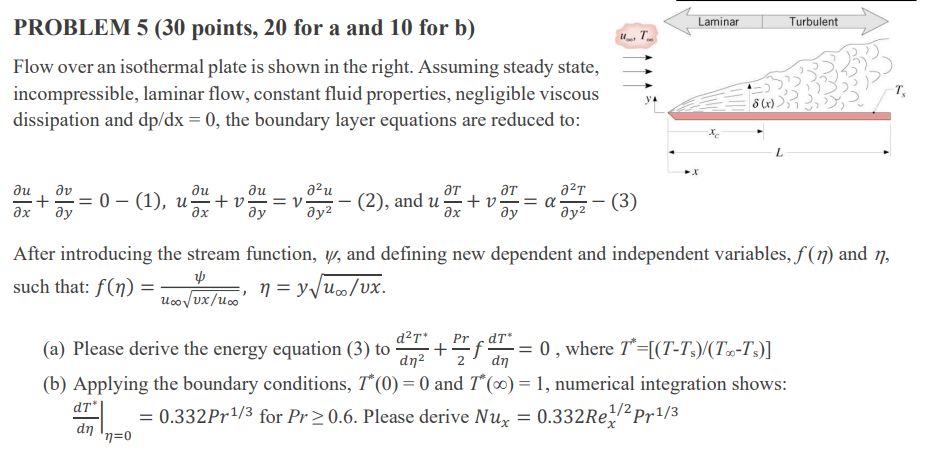
Flow over an isothermal plate is shown in the right. Assuming
steady state, incompressible, laminar flow, constant fluid
properties, negligible viscous dissipation and dp/dx = 0, the
boundary layer equations are reduced to: డ௨ డ௫ + డ௩ డ௬ = 0 − (1), 𝑢
డ௨ డ௫ + 𝑣 డ௨ డ௬ = 𝜈 డ మ௨ డ௬మ − (2), and 𝑢 డ் డ௫ + 𝑣 డ் డ௬ = 𝛼 డ మ்
డ௬మ − (3) After introducing the stream function, , and defining
new dependent and independent variables, f () and , such that:
𝑓(𝜂) = ట ௨ಮඥజ௫ ௨⁄ ಮ , 𝜂 = 𝑦ඥ𝑢ஶ⁄𝜐𝑥. (a) Please derive the energy
equation (3) to ௗ మ் ∗ ௗఎమ + ଶ 𝑓 ௗ்∗ ௗఎ = 0 , where T
*=[(T-Ts)/(T∞-Ts)] (b) Applying the boundary conditions, T * (0) =
0 and T * (∞) = 1, numerical integration shows: ௗ்∗ ௗఎ ቚ ఎୀ =
0.332𝑃𝑟ଵ/ଷ for Pr ≥ 0.6. Please derive 𝑁𝑢௫ = 0.332𝑅𝑒௫ ଵ/ଶ𝑃𝑟ଵ/
- Flow Over An Isothermal Plate Is Shown In The Right Assuming Steady State Incompressible Laminar Flow Constant Fluid 1 (127.08 KiB) Viewed 34 times
Laminar Turbulent HT PROBLEM 5 (30 points, 20 for a and 10 for b) Flow over an isothermal plate is shown in the right. Assuming steady state, incompressible, laminar flow, constant fluid properties, negligible viscous dissipation and dp/dx = 0, the boundary layer equations are reduced to: 8(x) 22T du av + ax ду = 0 – (1), u ди ди +v дх ду a2u ay2 ат ат (2), and u +1=a ду ду2 (3) дх After introducing the stream function, y, and defining new dependent and independent variables, f(n) and 7, such that: f(n) = 4 ; n = y/4.0/UX. u Looyux/u๒ Pr dT d27* dn2 2 dn (a) Please derive the energy equation (3) to + sar" -= 0, where T* =[(T-T;)/(T.-T;)] (b) Applying the boundary conditions, T*(0) = 0 and T* (C) = 1, numerical integration shows: dt = 0.332Pr1/3 for Pr>0.6. Please derive Nux = 0.332Rel/2Pr1/3 dn 'n=0