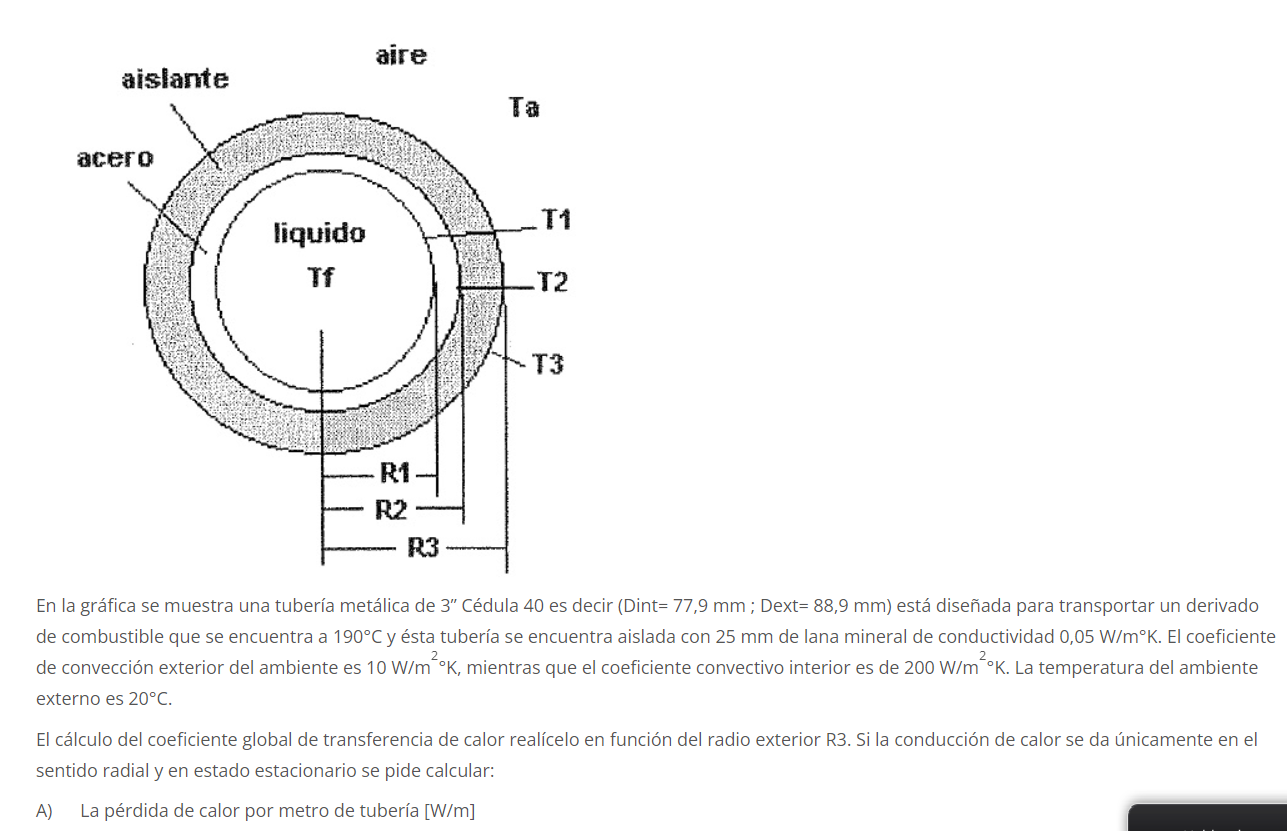
The graph shows a 3” Schedule 40 metal pipe, that is, (Dint=
77.9 mm; Dext= 88.9 mm) is designed to transport a fuel derivative
that is at 190°C and this pipe is located insulated with 25 mm of
mineral wool with a conductivity of 0.05 W/m°K. The external
convection coefficient of the environment is 10 W/m2°K, while the
internal convective coefficient is 200 W/m2°K. The external
environment temperature is 20°C.
The calculation of the global heat transfer coefficient is
carried out based on the outer radius R3. If the heat conduction
occurs only in the radial direction and in a steady state,
calculate:
A) Heat loss per meter of pipe [W/m]
- The Graph Shows A 3 Schedule 40 Metal Pipe That Is Dint 77 9 Mm Dext 88 9 Mm Is Designed To Transport A Fuel Der 1 (194.31 KiB) Viewed 40 times
aire aislante Ta acero T1 liquido Tf T2 T3 R1 R2 R3 En la gráfica se muestra una tubería metálica de 3" Cédula 40 es decir (Dint= 77,9 mm; Dext= 88,9 mm) está diseñada para transportar un derivado de combustible que se encuentra a 190°C y ésta tubería se encuentra aislada con 25 mm de lana mineral de conductividad 0,05 W/mK. El coeficiente de convección exterior del ambiente es 10 W/m²K, mientras que el coeficiente convectivo interior es de 200 W/m²K. La temperatura del ambiente externo es 20°C. 2 El cálculo del coeficiente global de transferencia de calor realícelo en función del radio exterior R3. Si la conducción de calor se da únicamente en el sentido radial y en estado estacionario se pide calcular: A) La pérdida de calor por metro de tubería [W/m]