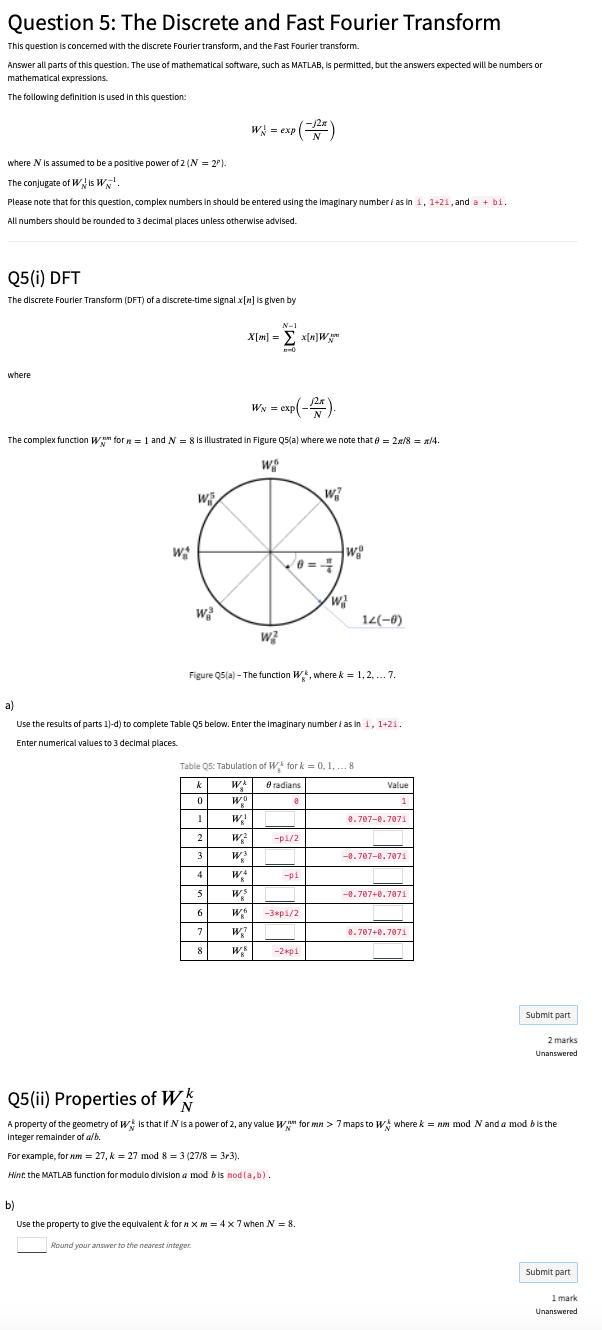
- Question 5 The Discrete And Fast Fourier Transform This Question Is Concerned With The Discrete Fourier Transform An 1 (97.85 KiB) Viewed 40 times
Question 5: The Discrete and Fast Fourier Transform . This question is concerned with the discrete Fourier transform, and the Fast Fourier transform. Answer all parts of this question. The use of mathematical software, such as MATLAB, is permitted, but the answers expected will be numbers or mathematical expressions. The following definition is used in this question: 12 W. = exp) (一) where N is assumed to be a positive power of 2 (N = 2P). The conjugate of wiswy. Please note that for this question, complex numbers in should be entered using the Imaginary number i as in 1, 1+2i, and a + bi. All numbers should be rounded to 3 decimal places unless otherwise advised. 3 . Q5(i) DFT The discrete Fourler Transform (DFT) of a discrete-time signal x[n] is given by N-1 X[nl] = Σ κ[n]W,τι where Ws = exp(-) 2 The complex function for n = 1 and N = 8 Is illustrated in Figure 05(a) where we note that 0 = 2x/8 = x/4. W. W W. w wi W: 8= w WA 12(-6) W] Figure 05(a) - The function W., where k = 1,2,... 7. a) Use the results of parts 1-d) to complete Table Q5 below. Enter the Imaginary numberi as in 1, 1+21. + . Table Q5: Tabulation of W, fork = 0,1.... 8 1, 8 Enter numerical values to 3 decimal places. k W e radians Value 0 wo 1 1 0.787-2.7871 2 - 1/2 W w w W W w 3 -8.707-0.7071 4 -pi 5 w -8.707+0.7071 6 -3pi/2 7 W 0.787+0.7871 8 8 w -2xpi Submit part 2 marks Unanswered N Q5(ii) Properties of W N A property of the geometry of wis that if N is a power of 2 any value for mn > 7 maps to w where k = nm mod N and a mod bis the Integer remainder of a/b. For example, form = 27, k = 27 mod 8 = 3 (27/8 = 3r3) Hint the MATLAB function for modulo division a mod bis nod(a,b). ). b) Use the property to give the equivalent k forn x m= 4 x 7 when N = 8. = 4 N = Round your answer to the nearest integer Submit part 1 mark Unanswered
c) Give the angle (in radians) of the complex number W X4 Submit part 1 mark Unanswered d) Give the equivalent value of W," k < 8 illustrated in Figure 05(a) for W. **) Note, should be entered as W_gºk. Submit part 1 mark Unanswered Q5(iii) - The Discrete Fourier Transform (DFT) e) An 8-point sequence x is defined as -x X[n] = (0, 0, 0, I, I, I, I, 0) 0, , 1 Use the results of parts Question 50 parts a)-d), or some other method, to compute the Discrete Fourier Transform X[6). Enter complex numbers using the imaginary number i as in 1, 1+2i, and a + bi. Submit part I mark Unanswered f) Use the MATLAB tft function to compute the DFT of the 8-point sequence - x = (7, 6, 5, 4, 3, 2, 1, 0). . Enter complex values in the form 1+2i. Enter numbers to 3 places of decimals. X[0] = X[1] X[2] = X[3] = X[4) = X[5] = X[6] = X[7] = Submit part 2 marks Unanswered Q5(iv) The Fast-Fourier Transform (FFT) The FFT is applied to a sequence x that is 2 samples long. Approximately how many complex operations are required for this operation? An Integer expected. . Hound your answer to the nearest integer Submit part 1 mark Unanswered h) How much more efficient is the 2-point FFT compared to the DFT defined in 050? Give your answer as the ratio of the approximate number of complex operations needed to compute the FFT versus the approximate number of complex operations needed to compute the DFT. Give your answer as a percentage. Round your answer to 3 significant figures. Submit part 1 mark Unanswered Submit all parts 10 marks