- Question 2 A Let X Have A Poisson Distribution With Parameter 1 1 Determine Kx T The Cumulant Generating Functio 1 (46.58 KiB) Viewed 27 times
- Question 2 A Let X Have A Poisson Distribution With Parameter 1 1 Determine Kx T The Cumulant Generating Functio 2 (21.68 KiB) Viewed 27 times
- Question 2 A Let X Have A Poisson Distribution With Parameter 1 1 Determine Kx T The Cumulant Generating Functio 3 (44.21 KiB) Viewed 27 times
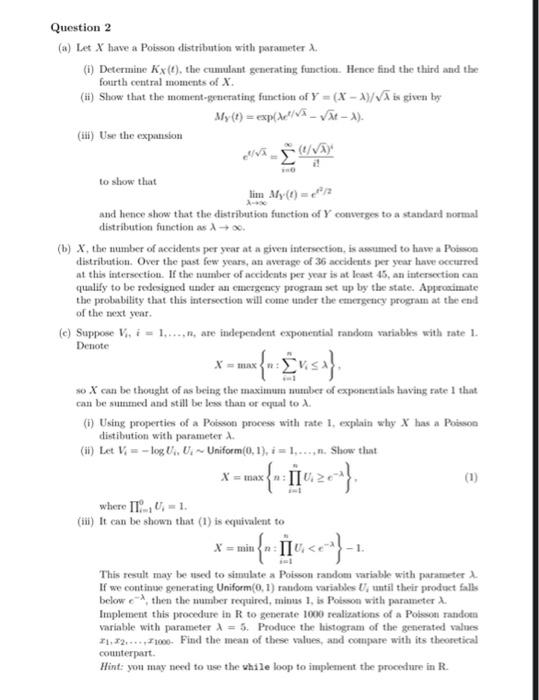
Question 2 (a) Let X have a Poisson distribution with parameter 1. (1) Determine Kx (t), the cumulant generating function. Hence find the third and the fourth central moments of X. (1) Show that the moment-generating function of Y = (x – A/V is given by My(t) = exp(de"/18 - Vit - 1) (ii) Use the expansson (t/vy to show that in My(t) = 2/2 and hence show that the distribution function of Y converges to a standard normal distribution function as → (b) X, the number of accidents per year at a given intersection is assumed to have a Poisson distribution. Over the past few years, an average of 36 accidents per year have occurred at this intersection. If the number of accidents per year is at least 45, an intersection can qunlify to be redesigned under an emergency program set up by the state. Approximate the probability that this intersection will come under the emergency program at the end of the next year (e) Suppose V, i = 1,..., are independent exponential random variables with rate 1 Denote X-max 30 X can be thought of as being the maximum number of exponuntinly having rate 1 that can be summed and still be less than or equal to (6) Using properties of a Poisson process with rate 1, explain why X has a Poisson distibution with parameter (ii) Let V-hopU.U. - Uniform(0,1), i = 1,.... Show that X = max: (1) where ITO, U = 1. (ii) It can be shown that (1) is equivalent to X = This result may be used to simulate a Poisson random variable with parameter If we continte generating Uniform(0.1) ratudot variables U, tintil their product falls below then the mimber required, mintas 1, is Poisson with parameter d. Implement this procedure in R to generate 1000 realizations of a Poisson random variable with parameter 1 = 5. Produce the histogram of the generated values 11.12.2000. Find the mean of these values, and compare with its theoretical counterpart. Hint: you may need to use the while loop to implement the procedure in R. {- Iluze}, -min{» Ilu«<ey}--
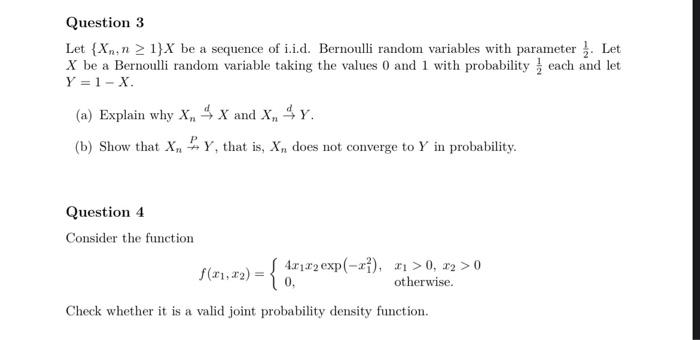
Question 3 Let {Xn, n > 1}X be a sequence of i.i.d. Bernoulli random variables with parameter 1. Let X be a Bernoulli random variable taking the values 0 and 1 with probability į each and let Y = 1 - X (a) Explain why X, X and X, Y. (b) Show that xn fythat is, X, does not converge to Y in probability. Question 4 Consider the function $(0,02) = { 4.1172 exp(-x), 11 > 0, >2 > 0 otherwise. Check whether it is a valid joint probability density function.
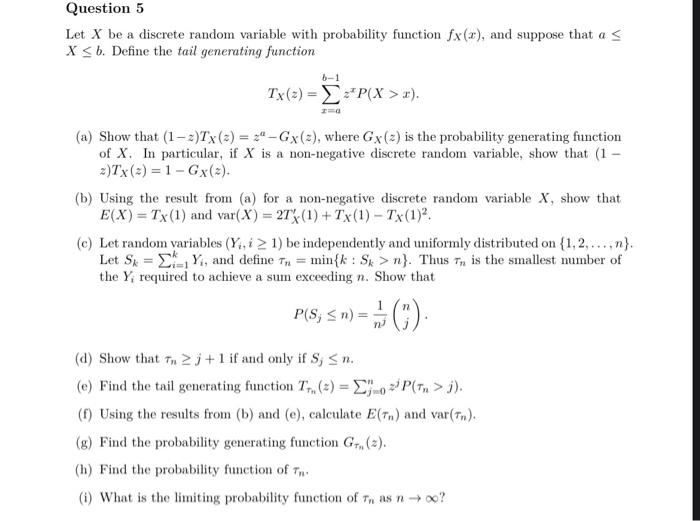
Question 5 Let X be a discrete random variable with probability function fx(:), and suppose that as X Sb. Define the tail generating function b-1 Tx(x) = P(x >r). (a) Show that (1-2)Tx(x) = 24-Gx(), where Gx (2) is the probability generating function of X. In particular, if X is a non-negative discrete random variable, show that (1 - 2)Tx(z) = 1 - Gx(2). (b) Using the result from (a) for a non-negative discrete random variable X, show that E(X) = Tx(1) and var(X) = 27 (1) + Tx(1) - Tx(1) (c) Let random variables (Y., i > 1) be independently and uniformly distributed on {1,2,...,n}. Let S = Dk, Yi, and define Tn = min{k: Sk>n}. Thus Tn is the smallest number of the Y, required to achieve a sum exceeding n. Show that P(S, <n) 1 (%). n (d) Show that thj+1 if and only if S, Sn. (e) Find the tail generating function T., (z) = ;..P(Tn>

. (f) Using the results from (b) and (e), calculate E(Tn) and var(Tn). (8) Find the probability generating function G. (2). (h) Find the probability function of the (0) What is the limiting probability function of Tn as no?