Page 1 of 1
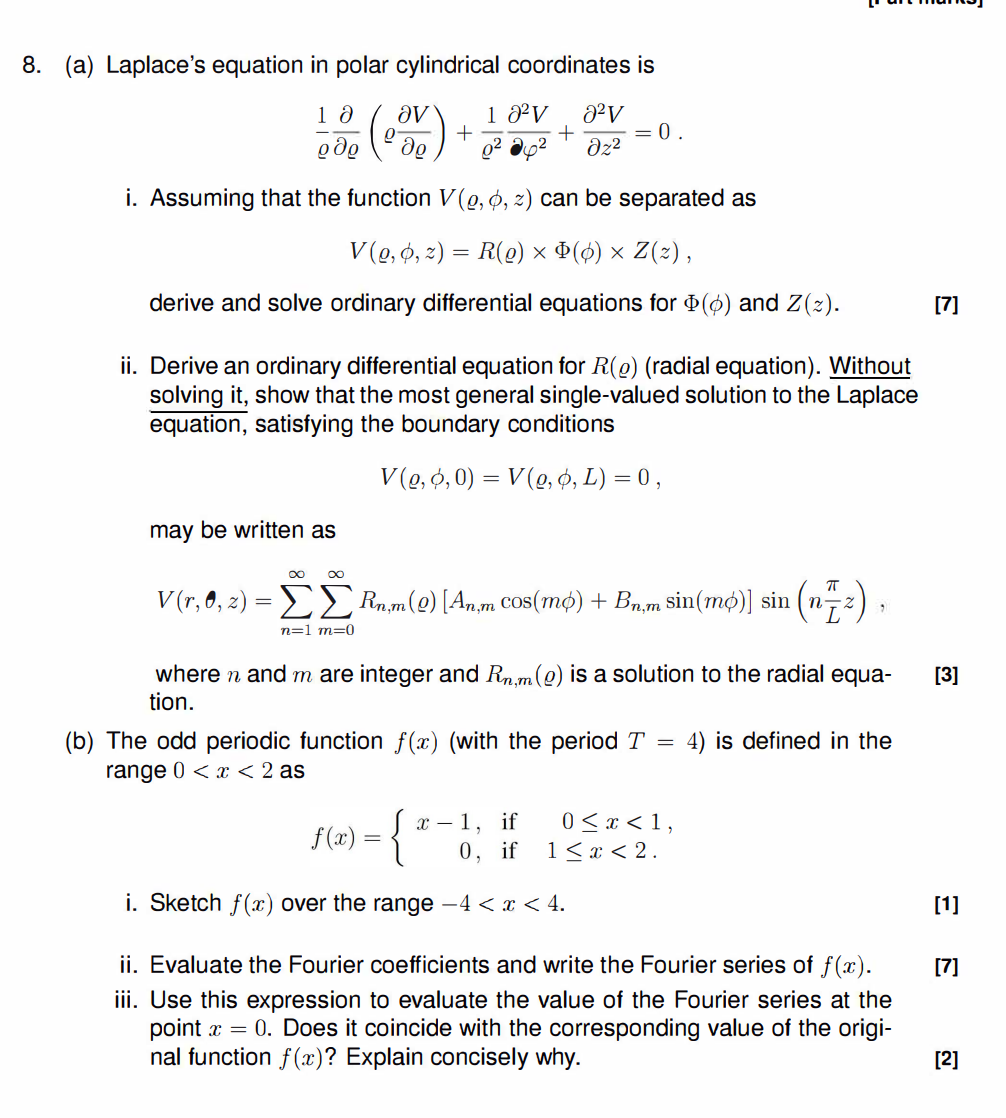
8. (a) Laplace's equation in polar cylindrical coordinates is 1 a 1 02 bolo av მე + a2V + дz2 = 0. i. Assuming that the
Posted: Fri Apr 29, 2022 11:41 am
by answerhappygod
- 1 (340.09 KiB) Viewed 21 times
8. (a) Laplace's equation in polar cylindrical coordinates is 1 a 1 02 bolo av მე + a2V + дz2 = 0. i. Assuming that the function V(0, 0, z) can be separated as V(0,0, 2) = R(0) x 0(0) * Z(2), derive and solve ordinary differential equations for o(o) and Z(z). = [7] ii. Derive an ordinary differential equation for R(q) (radial equation). Without solving it, show that the most general single-valued solution to the Laplace equation, satisfying the boundary conditions V(0,0,0) = V(0, 0, L) = 0, may be written as oo oo 7T V (r,0, 2) = Rum() [An m cos(mø) + Brım sin(mo)] sin (»Iz), = n=l m=0 [3] where n and m are integer and Rn,m(@) is a solution to the radial equa- tion. (b) The odd periodic function f(c) (with the period T 4) is defined in the range 0 < x < 2 as = f(x) = { X-1, if 0, if 0<x<1, 1<3 < 2. i. Sketch f(x) over the range -4 < x < 4. [1] [7] ii. Evaluate the Fourier coefficients and write the Fourier series of f(x). iii. Use this expression to evaluate the value of the Fourier series at the point x = 0. Does it coincide with the corresponding value of the origi- nal function f(x)? Explain concisely why. [2]