Page 1 of 1
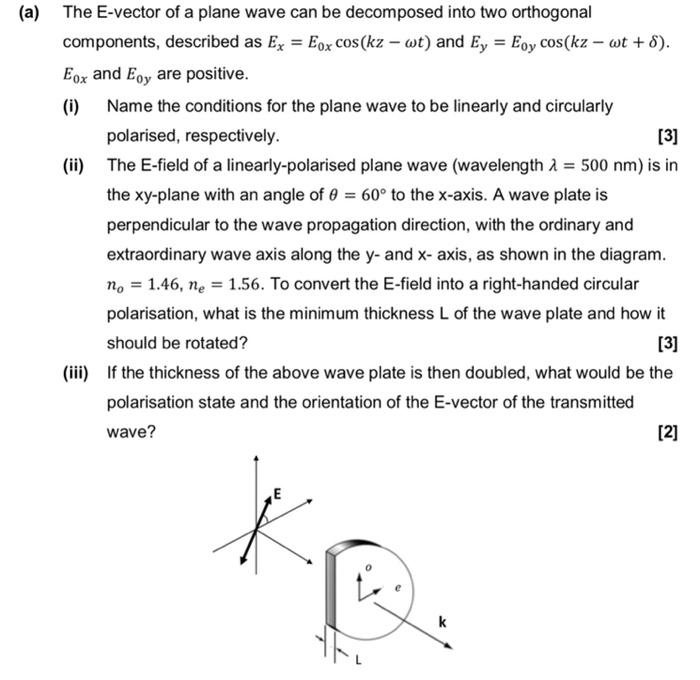
(a) The E-vector of a plane wave can be decomposed into two orthogonal components, described as Ex = Eox cos(kz – wt) an
Posted: Fri Apr 29, 2022 11:38 am
by answerhappygod
- A The E Vector Of A Plane Wave Can Be Decomposed Into Two Orthogonal Components Described As Ex Eox Cos Kz Wt An 1 (59.14 KiB) Viewed 25 times
(a) The E-vector of a plane wave can be decomposed into two orthogonal components, described as Ex = Eox cos(kz – wt) and Ey = Eoy cos(kz – wt +8). Eox and Eoy are positive. (i) Name the conditions for the plane wave to be linearly and circularly polarised, respectively. [3] (ii) The E-field of a linearly-polarised plane wave (wavelength 2 = 500 nm) is in the xy-plane with an angle of 0 = 60° to the x-axis. A wave plate is perpendicular to the wave propagation direction, with the ordinary and extraordinary wave axis along the y- and x-axis, as shown in the diagram. no = 1.46, ne = 1.56. To convert the E-field into a right-handed circular polarisation, what is the minimum thickness L of the wave plate and how it should be rotated? [3] (iii) If the thickness of the above wave plate is then doubled, what would be the polarisation state and the orientation of the E-vector of the transmitted wave? [2] E L k 今