Page 1 of 1
3) Assume that the rotation curve of the Milky Way - its circular speed V (r) as a function of galactocentric radius r,
Posted: Fri Apr 29, 2022 11:26 am
by answerhappygod
- 3 Assume That The Rotation Curve Of The Milky Way Its Circular Speed V R As A Function Of Galactocentric Radius R 1 (77.87 KiB) Viewed 24 times
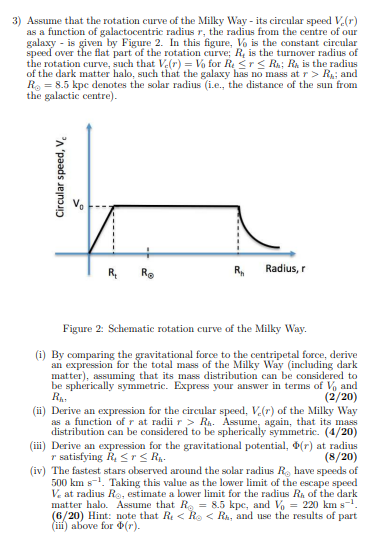
3) Assume that the rotation curve of the Milky Way - its circular speed V (r) as a function of galactocentric radius r, the radius from the centre of our galaxy - is given by Figure 2. In this figure, Vo is the constant circular speed over the flat part of the rotation curve: R is the turnover radius of the rotation curve, such that V.(r) = Vo for Recr<R: R is the radius of the dark matter halo, such that the galaxy has no mass at r > Rand R. = 8.5 kpc denotes the solar radius (i.e., the distance of the sun from the galactic centre) Circular speed, V RA Radius, Figure 2: Schematic rotation curve of the Milky Way. (i) By comparing the gravitational force to the centripetal force, derive an expression for the total mass of the Milky Way (including dark matter), assuming that its mass distribution can be considered to be spherically symmetric. Express your answer in terms of V, and R (2/20) (ii) Derive an expression for the circular speed. V.(r) of the Milky Way as a function of r at radii r > Rn. Assume, again, that its mass distribution can be considered to be spherically symmetric. (4/20) (iii) Derive an expression for the gravitational potential, o(r) at radius r satisfying R, STER (8/20) (iv) The fastest stars observed around the solar radius R. have speeds of 500 km - Taking this value as the lower limit of the escape speed V. at radius R, estimate a lower limit for the radius Rh of the dark matter halo. Assume that R. = 8.5 kpc, and V = 220 km s-1 (6/20) Hint: note that Re<R <Rs, and use the results of part (iii) above for (r).