Page 1 of 1
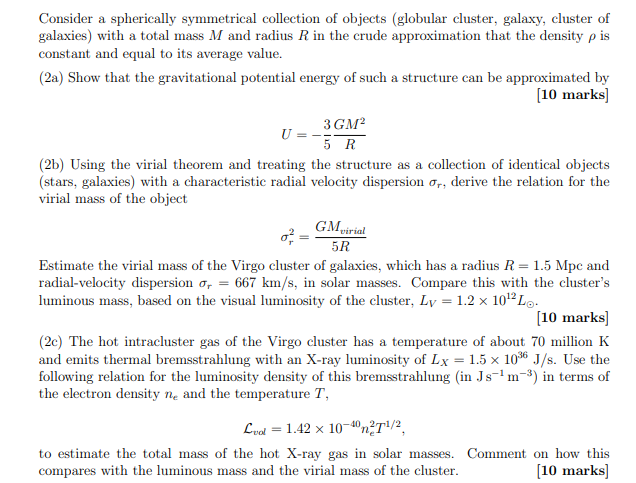
Consider a spherically symmetrical collection of objects (globular cluster, galaxy, cluster of galaxies) with a total ma
Posted: Fri Apr 29, 2022 11:25 am
by answerhappygod
- Consider A Spherically Symmetrical Collection Of Objects Globular Cluster Galaxy Cluster Of Galaxies With A Total Ma 1 (107.81 KiB) Viewed 22 times
Consider a spherically symmetrical collection of objects (globular cluster, galaxy, cluster of galaxies) with a total mass M and radius R in the crude approximation that the density p is constant and equal to its average value. (2a) Show that the gravitational potential energy of such a structure can be approximated by [10 marks] 3 GMP U 5 R (25) Using the virial theorem and treating the structure as a collection of identical objects (stars, galaxies) with a characteristic radial velocity dispersion Or, derive the relation for the virial mass of the object GMvirial 5R Estimate the virial mass of the Virgo cluster of galaxies, which has a radius R=1.5 Mpe and radial-velocity dispersion or = 667 km/s, in solar masses. Compare this with the cluster's luminous mass, based on the visual luminosity of the cluster, Lv = 1.2 x 10¹²L (10 marks) (2c) The hot intracluster gas of the Virgo cluster has a temperature of about 70 million K and emits thermal bremsstrahlung with an X-ray luminosity of Lx = 1.5 x 1036 J/s. Use the following relation for the luminosity density of this bremsstrahlung (in Js-'m-*) in terms of the electron density ne and the temperature T, Luar = 1.42 x 10-40,271/2, to estimate the total mass of the hot X-ray gas in solar masses. Comment on how this compares with the luminous mass and the virial mass of the cluster. (10 marks)