Page 1 of 1
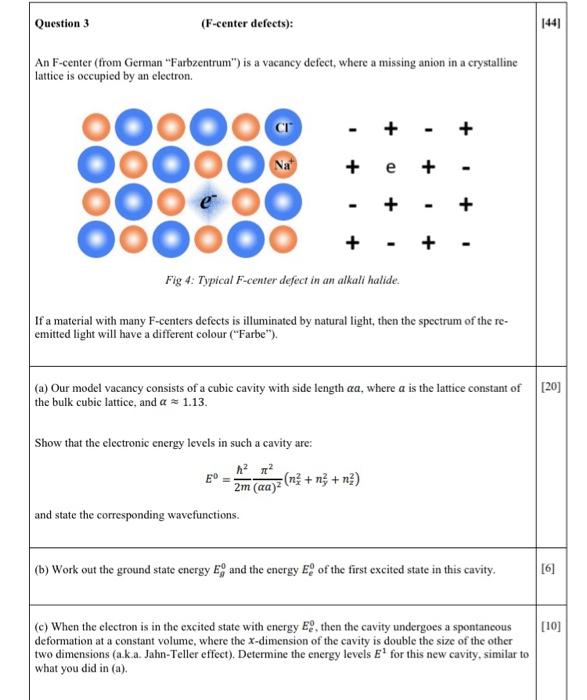
Question 3 (F-center defects): 1441 An F-center (from German "Fartzentrum") is a vacancy defect, where a missing anion i
Posted: Fri Apr 29, 2022 10:45 am
by answerhappygod
- Question 3 F Center Defects 1441 An F Center From German Fartzentrum Is A Vacancy Defect Where A Missing Anion I 1 (52.16 KiB) Viewed 26 times
- Question 3 F Center Defects 1441 An F Center From German Fartzentrum Is A Vacancy Defect Where A Missing Anion I 2 (24.38 KiB) Viewed 26 times
Question 3 (F-center defects): 1441 An F-center (from German "Fartzentrum") is a vacancy defect, where a missing anion in a crystalline lattice is occupied by an electron. + - + + e + - ood e ood - + + + - + + - Fig 4: Typical F-center defect in an alkali halide. If a material with many F-centers defects is illuminated by natural light, then the spectrum of the re- emitted light will have a different colour ("Farbe"). (a) Our model vacancy consists of a cubic cavity with side length ca, where a is the lattice constant of [20] the bulk cubic lattice, and a = 1.13. Show that the electronic energy levels in such a cavity are: A ?? 2m (aa) (n} + n2 +n3) and state the corresponding wavefunctions. ED (6) Work out the ground state energy E, and the energy of the first excited state in this cavity. (62 [10] () When the electron is in the excited state with energy E, then the cavity undergoes a spontaneous deformation at a constant volume, where the X-dimension of the cavity is double the size of the other two dimensions (a.k.a. Jahn-Teller effect). Determine the energy levels El for this new cavity, similar to what you did in (a).
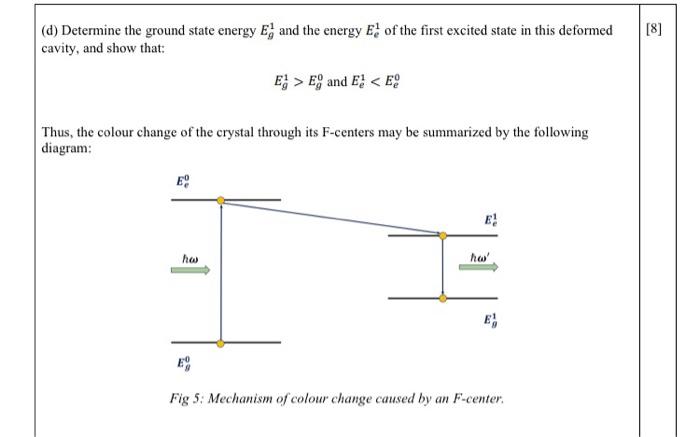
[8] (d) Determine the ground state energy E, and the energy of the first excited state in this deformed cavity, and show that: Ej > Ey and ES <E Thus, the colour change of the crystal through its F-centers may be summarized by the following diagram: E ES hw hw Fig 5: Mechanism of colour change caused by an F-center