Page 1 of 1
QB2: Velocity Triangle, AOA, Flow Separation and Secondary Flow The idealized compressive dynamic turbo-machine achieves
Posted: Fri Apr 29, 2022 9:57 am
by answerhappygod
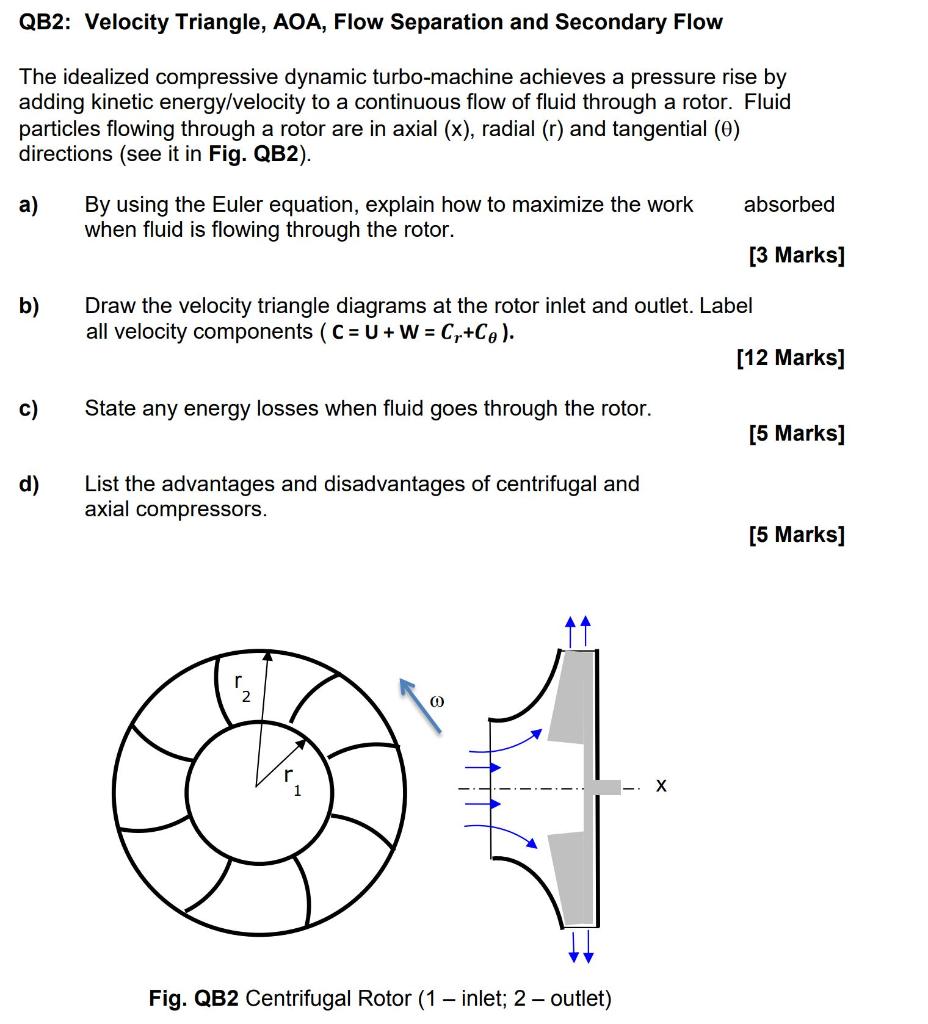
- Qb2 Velocity Triangle Aoa Flow Separation And Secondary Flow The Idealized Compressive Dynamic Turbo Machine Achieves 1 (102.76 KiB) Viewed 15 times
QB2: Velocity Triangle, AOA, Flow Separation and Secondary Flow The idealized compressive dynamic turbo-machine achieves a pressure rise by adding kinetic energy/velocity to a continuous flow of fluid through a rotor. Fluid particles flowing through a rotor are in axial (x), radial (r) and tangential (0) directions (see it in Fig. QB2). a) absorbed By using the Euler equation, explain how to maximize the work when fluid is flowing through the rotor. [3 Marks] b) Draw the velocity triangle diagrams at the rotor inlet and outlet. Label all velocity components (C = U+W = C,+Ce). [12 Marks] C) State any energy losses when fluid goes through the rotor. [5 Marks] d) List the advantages and disadvantages of centrifugal and axial compressors. [5 Marks] 2 0 х Fig. QB2 Centrifugal Rotor (1 - inlet; 2 - outlet)