Page 1 of 1
Q5 (total 50 points) [From Professor Wen J Li] A MEMS sensor that is used to measure velocity and acceleration can be mo
Posted: Fri Apr 29, 2022 9:56 am
by answerhappygod
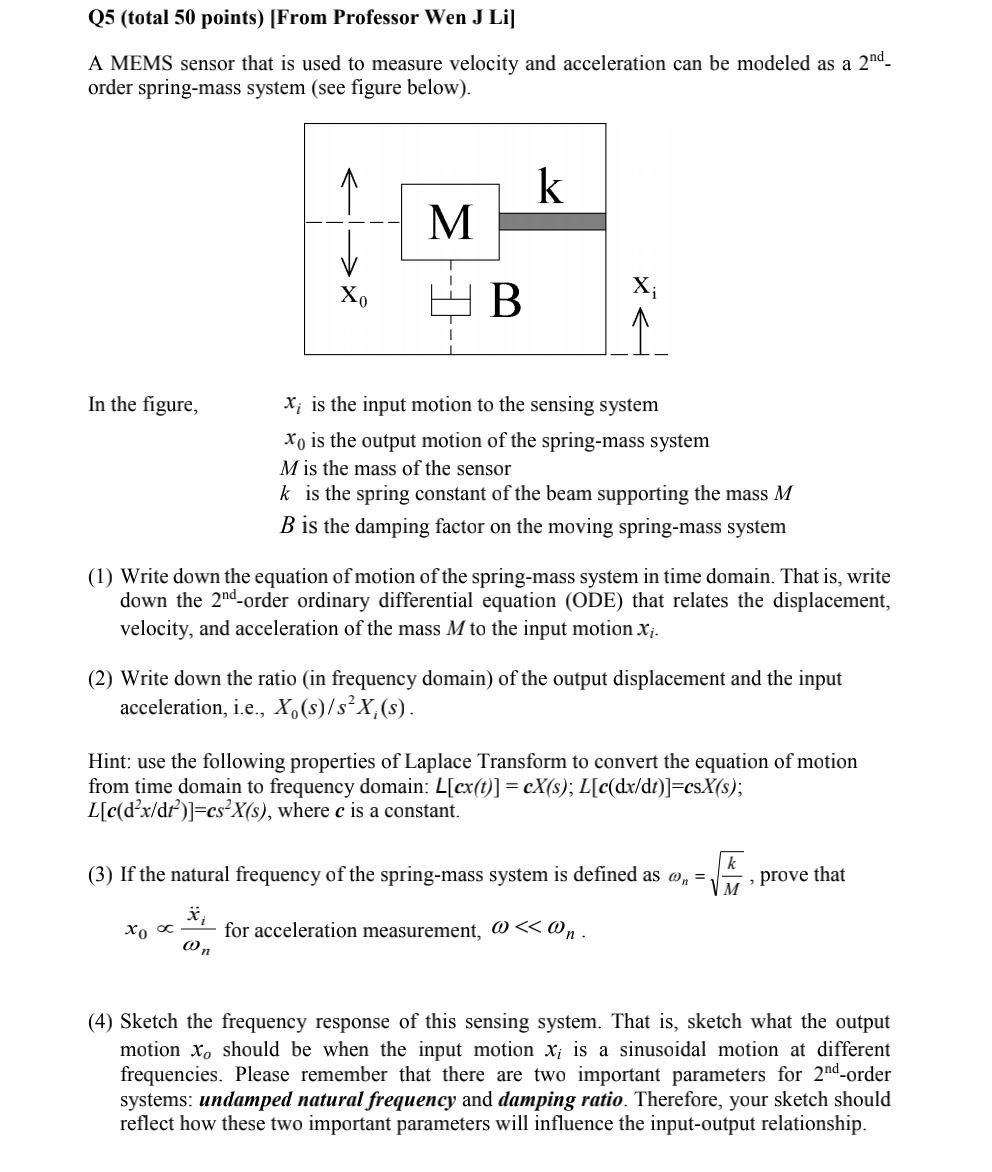
- Q5 Total 50 Points From Professor Wen J Li A Mems Sensor That Is Used To Measure Velocity And Acceleration Can Be Mo 1 (176.14 KiB) Viewed 18 times
Q5 (total 50 points) [From Professor Wen J Li] A MEMS sensor that is used to measure velocity and acceleration can be modeled as a 2nd- order spring-mass system (see figure below). k ΣΕ M Xo B X In the figure, x; is the input motion to the sensing system Xo is the output motion of the spring-mass system M is the mass of the sensor k is the spring constant of the beam supporting the mass M B is the damping factor on the moving spring-mass system (1) Write down the equation of motion of the spring-mass system in time domain. That is, write down the 2nd-order ordinary differential equation (ODE) that relates the displacement, velocity, and acceleration of the mass M to the input motion Xị. (2) Write down the ratio (in frequency domain) of the output displacement and the input acceleration, i.e., X,(s)/s²X;($). Hint: use the following properties of Laplace Transform to convert the equation of motion from time domain to frequency domain: L[cx(t)] = cX(s); L[c(dx/dt)]=csX(s); L[c(dx/dt)]=cs-X(s), where c is a constant. k (3) If the natural frequency of the spring-mass system is defined as on=, , prove that * хо for acceleration measurement, 0 << On. on (4) Sketch the frequency response of this sensing system. That is, sketch what the output motion x, should be when the input motion Xi is a sinusoidal motion at different frequencies. Please remember that there are two important parameters for 2nd-order systems: undamped natural frequency and damping ratio. Therefore, your sketch should reflect how these two important parameters will influence the input-output relationship.