Page 1 of 1
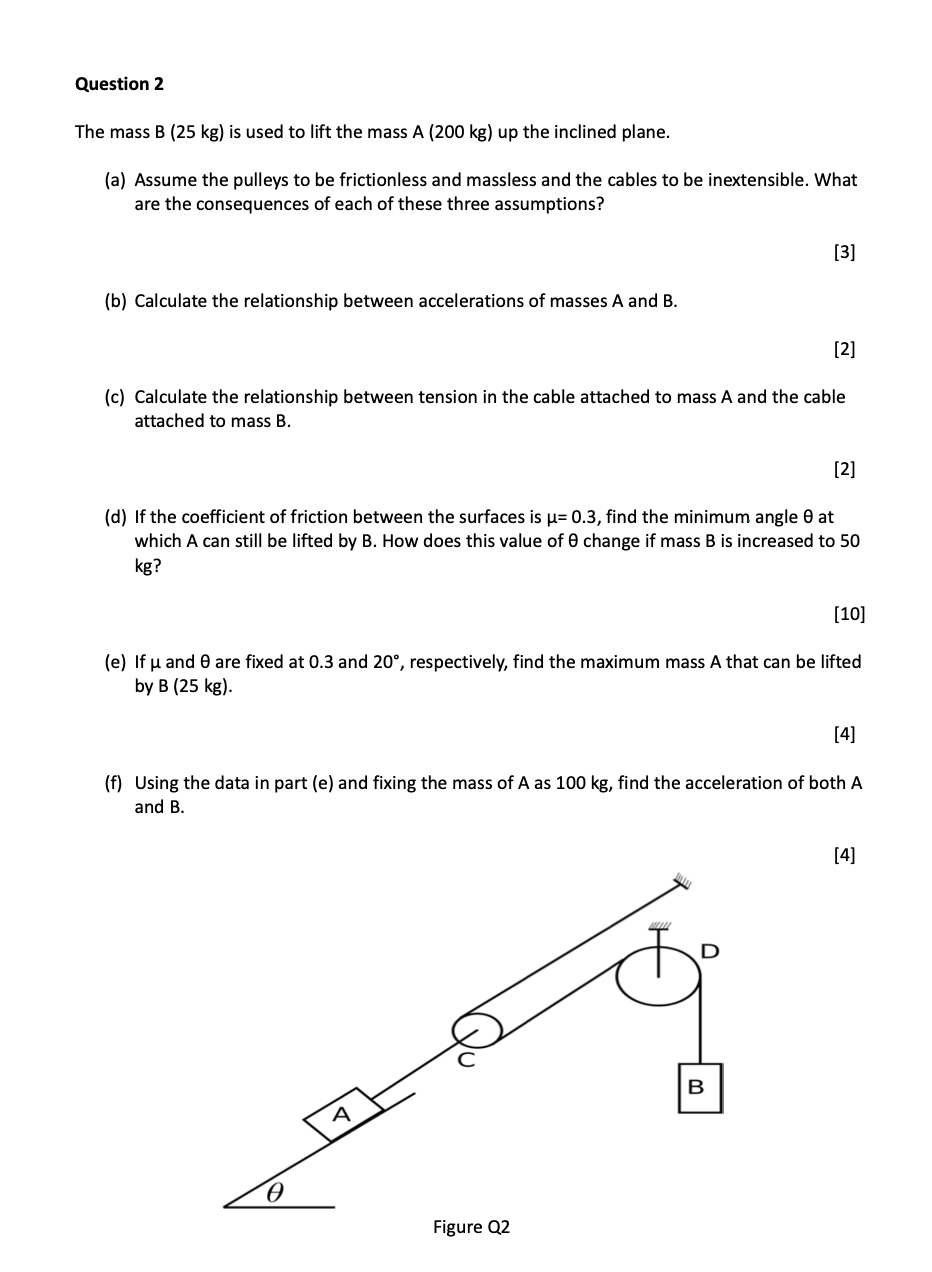
Question 2 The mass B (25 kg) is used to lift the mass A (200 kg) up the inclined plane. (a) Assume the pulleys to be fr
Posted: Fri Apr 29, 2022 9:48 am
by answerhappygod
- Question 2 The Mass B 25 Kg Is Used To Lift The Mass A 200 Kg Up The Inclined Plane A Assume The Pulleys To Be Fr 1 (98.37 KiB) Viewed 15 times
Question 2 The mass B (25 kg) is used to lift the mass A (200 kg) up the inclined plane. (a) Assume the pulleys to be frictionless and massless and the cables to be inextensible. What are the consequences of each of these three assumptions? [3] (b) Calculate the relationship between accelerations of masses A and B. [2] (c) Calculate the relationship between tension in the cable attached to mass A and the cable attached to mass B. [2] (d) If the coefficient of friction between the surfaces is u= 0.3, find the minimum angle o at which A can still be lifted by B. How does this value of change if mass B is increased to 50 kg? [10] (e) If u and are fixed at 0.3 and 20°, respectively, find the maximum mass A that can be lifted by B (25 kg). [4] (f) Using the data in part (e) and fixing the mass of A as 100 kg, find the acceleration of both A and B. [4] B A Figure Q2