Page 1 of 1
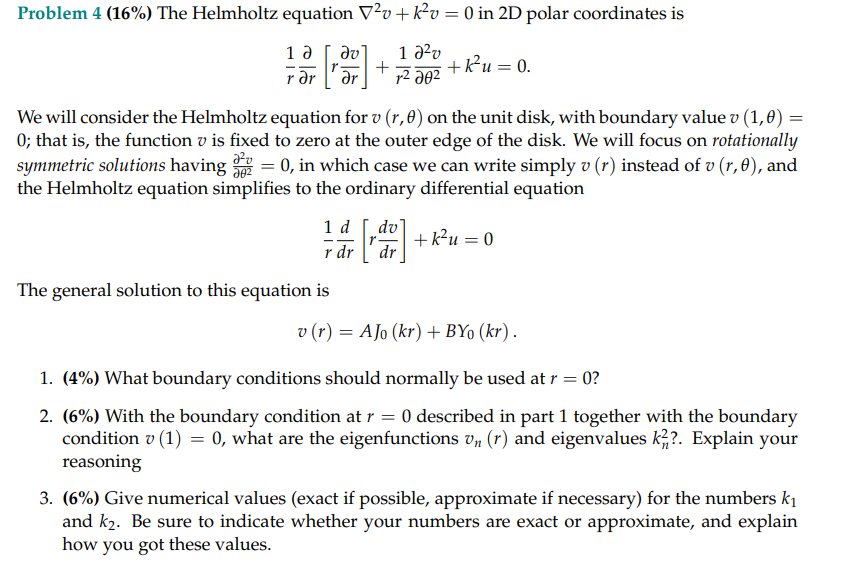
Problem 4 (16%) The Helmholtz equation v2v+k?v = 0 in 2D polar coordinates is 1 a av 1 220 + +k?u=0. rar l'ar r2 a82 We
Posted: Fri Apr 29, 2022 9:38 am
by answerhappygod
- Problem 4 16 The Helmholtz Equation V2v K V 0 In 2d Polar Coordinates Is 1 A Av 1 220 K U 0 Rar L Ar R2 A82 We 1 (138.37 KiB) Viewed 14 times
Problem 4 (16%) The Helmholtz equation v2v+k?v = 0 in 2D polar coordinates is 1 a av 1 220 + +k?u=0. rar l'ar r2 a82 We will consider the Helmholtz equation for v (r,6) on the unit disk, with boundary value v (1,0) = 0; that is, the function v is fixed to zero at the outer edge of the disk. We will focus on rotationally symmetric solutions having 32 = 0, in which case we can write simply v (r) instead of v (r,0), and 242 the Helmholtz equation simplifies to the ordinary differential equation 1d r dr (4 5] +k?u=0 dv dr The general solution to this equation is v (r) = AJo (kr) + BYO (kr). = 1. (4%) What boundary conditions should normally be used at r = 0? 2. (6%) With the boundary condition at r = 0 described in part 1 together with the boundary condition v (1) = 0, what are the eigenfunctions on (r) and eigenvalues k??. Explain your reasoning 3. (6%) Give numerical values (exact if possible, approximate if necessary) for the numbers kı and k2. Be sure to indicate whether your numbers are exact or approximate, and explain how you got these values.