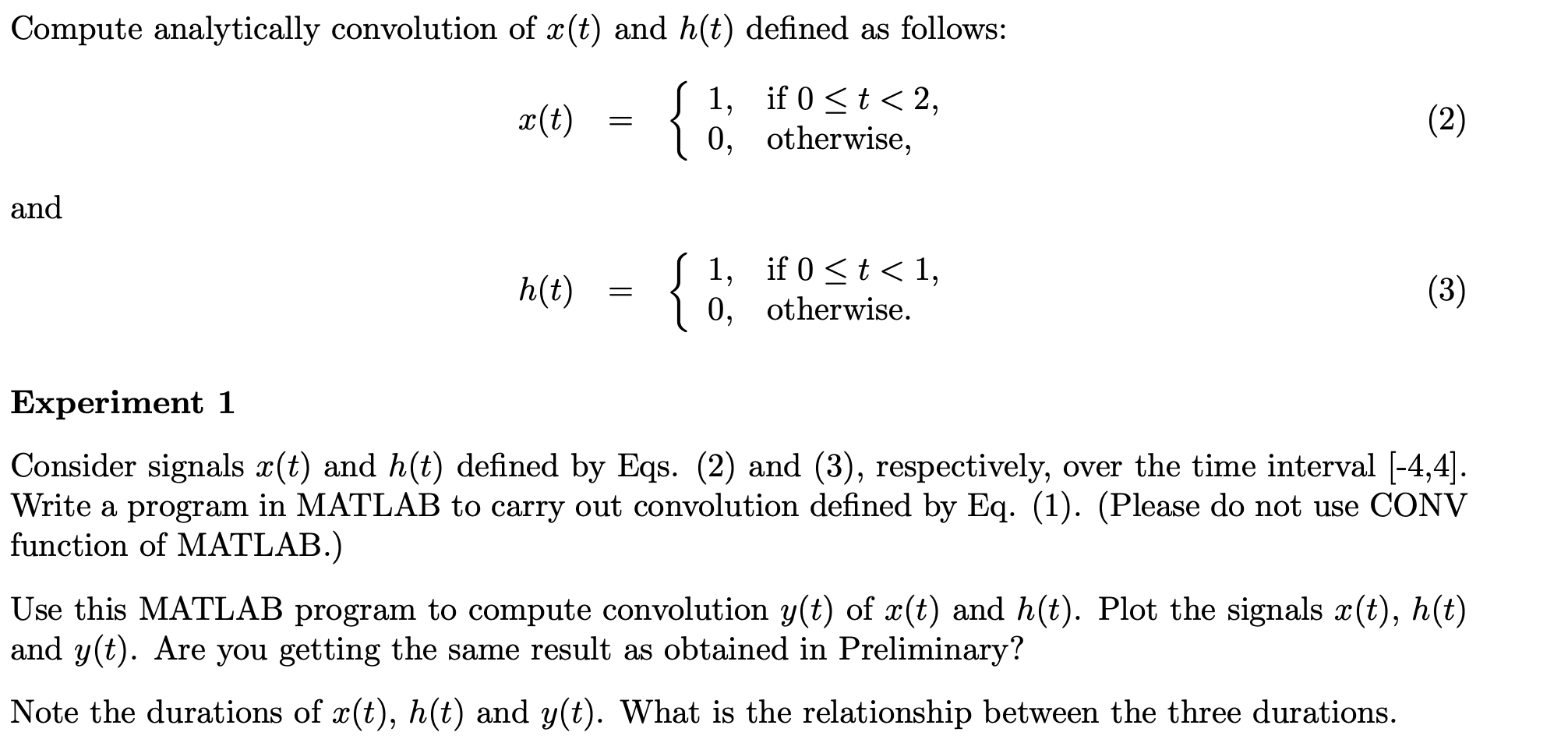
Compute analytically convolution of x(t) and h(t) defined as follows: x(t) = { 1, if 0
Posted: Fri Apr 29, 2022 8:56 am
- Compute Analytically Convolution Of X T And H T Defined As Follows X T 1 If 0 T 2 0 Otherwise 2 And H T 1 (143.93 KiB) Viewed 19 times
Compute analytically convolution of x(t) and h(t) defined as follows: x(t) = { 1, if 0 <t< 2, 0, otherwise, (2) and h(t) = { 1, if 0 <t<1, 0, otherwise. (3) Experiment 1 Consider signals x(t) and h(t) defined by Eqs. (2) and (3), respectively, over the time interval (-4,4]. Write a program in MATLAB to carry out convolution defined by Eq. (1). (Please do not use CONV function of MATLAB.) Use this MATLAB program to compute convolution y(t) of x(t) and h(t). Plot the signals x(t), h(t) and y(t). Are you getting the same result as obtained in Preliminary? Note the durations of x(t), h(t) and y(t). What is the relationship between the three durations.
Posted: Fri Apr 29, 2022 8:56 am
- Compute Analytically Convolution Of X T And H T Defined As Follows X T 1 If 0 T 2 0 Otherwise 2 And H T 1 (143.93 KiB) Viewed 19 times