Page 1 of 1
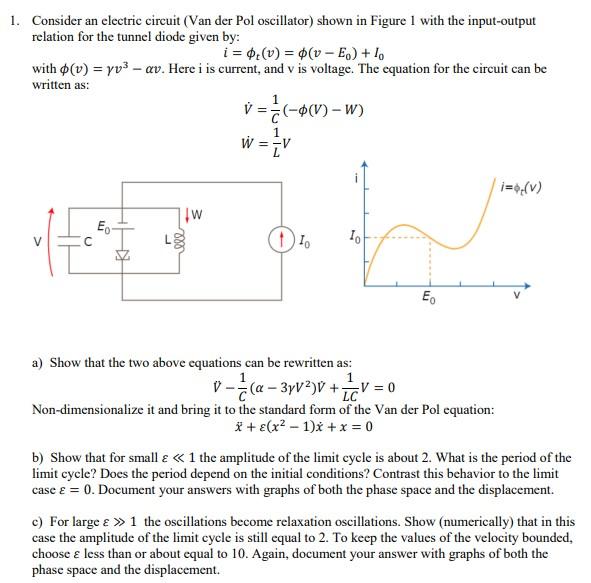
1. Consider an electric circuit (Van der Pol oscillator) shown in Figure 1 with the input-output relation for the tunnel
Posted: Fri Apr 29, 2022 8:21 am
by answerhappygod
- 1 Consider An Electric Circuit Van Der Pol Oscillator Shown In Figure 1 With The Input Output Relation For The Tunnel 1 (50.42 KiB) Viewed 21 times
1. Consider an electric circuit (Van der Pol oscillator) shown in Figure 1 with the input-output relation for the tunnel diode given by: i = 0; (v) = °(v - E.) +1 with (v) = y03 - av. Here i is current, and v is voltage. The equation for the circuit can be written as: 1 = {(-4(0)-w) ( 1 W = -1 i i= (V) Iw Eo le 11 10 E. a) Show that the two above equations can be rewritten as: 0-1 (a – 3yV2)V + ICV = 0 LC Non-dimensionalize it and bring it to the standard form of the Van der Pol equation: * +8(x2 - 1)+ x = 0 b) Show that for small & « 1 the amplitude of the limit cycle is about 2. What is the period of the limit cycle? Does the period depend on the initial conditions? Contrast this behavior to the limit case E = 0. Document your answers with graphs of both the phase space and the displacement. c) For large € > 1 the oscillations become relaxation oscillations. Show (numerically) that in this case the amplitude of the limit cycle is still equal to 2. To keep the values of the velocity bounded, choose a less than or about equal to 10. Again, document your answer with graphs of both the phase space and the displacement.