Page 1 of 1
1. Handle Simple Cases It is a good strategy to identify and deal with simple cases first. In this problem, notice that
Posted: Fri Apr 29, 2022 6:57 am
by answerhappygod
- 1 Handle Simple Cases It Is A Good Strategy To Identify And Deal With Simple Cases First In This Problem Notice That 1 (77.91 KiB) Viewed 32 times
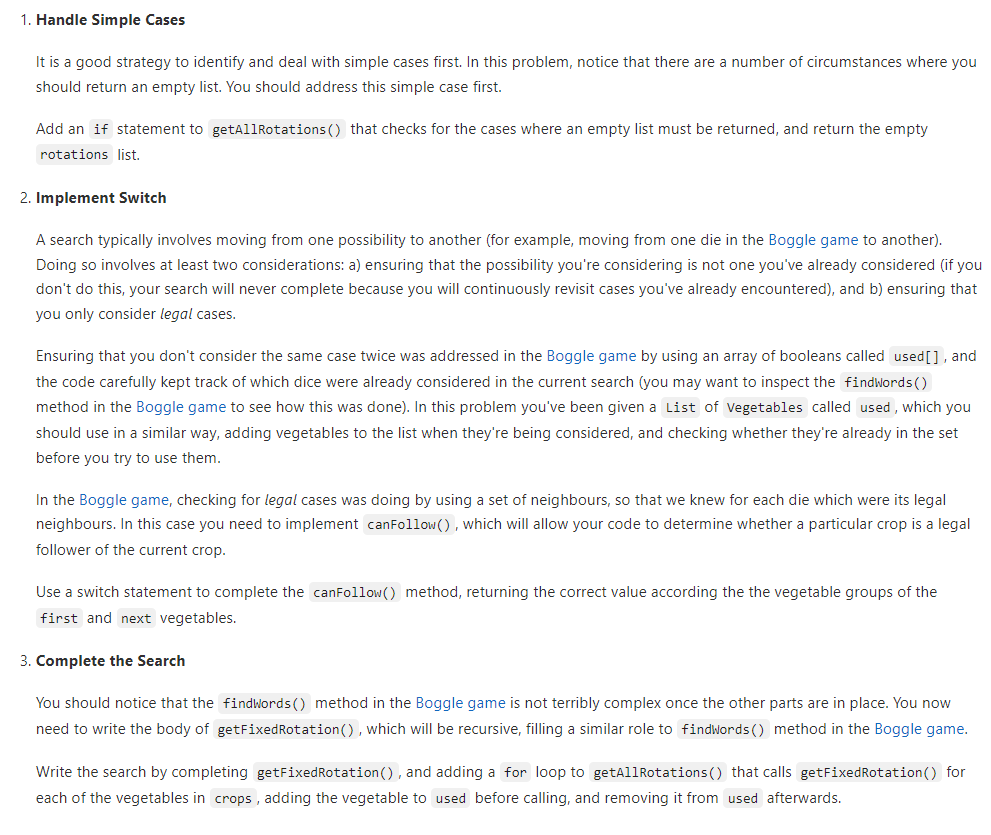
1. Handle Simple Cases It is a good strategy to identify and deal with simple cases first. In this problem, notice that there are a number of circumstances where you should return an empty list. You should address this simple case first. Add an if statement to getAllRotations() that checks for the cases where an empty list must be returned, and return the empty rotations list. 2. Implement Switch A search typically involves moving from one possibility to another (for example, moving from one die in the Boggle game to another). Doing so involves at least two considerations: a) ensuring that the possibility you're considering is not one you've already considered (if you don't do this, your search will never complete because you will continuously revisit cases you've already encountered), and b) ensuring that you only consider legal cases. Ensuring that you don't consider the same case twice was addressed in the Boggle game by using an array of booleans called used[], and the code carefully kept track of which dice were already considered in the current search (you may want to inspect the findWords) method in the Boggle game to see how this was done). In this problem you've been given a list of vegetables called used, which you should use in a similar way, adding vegetables to the list when they're being considered, and checking whether they're already in the set before you try to use them. In the Boggle game, checking for legal cases was doing by using a set of neighbours, so that we knew for each die which were its legal neighbours. In this case you need to implement canFollow(), which will allow your code to determine whether a particular crop is a legal follower of the current crop. Use a switch statement to complete the canFollow() method, returning the correct value according the the vegetable groups of the first and next vegetables. 3. Complete the Search You should notice that the findWords() method in the Boggle game is not terribly complex once the other parts are in place. You now need to write the body of getFixedRotation(), which will be recursive, filling a similar role to findWords() method in the Boggle game. Write the search by completing getFixedRotation(), and adding a for loop to getAllRotations() that calls getFixedRotation() for each of the vegetables in crops , adding the vegetable to used before calling, and removing it from used afterwards.