Page 1 of 1
EXAMPLE 4.2 The Value of U.S. National Parks In 2016, the National Park Service in the United States turned 100 years ol
Posted: Thu Apr 28, 2022 12:28 pm
by answerhappygod
- Example 4 2 The Value Of U S National Parks In 2016 The National Park Service In The United States Turned 100 Years Ol 1 (317.05 KiB) Viewed 25 times
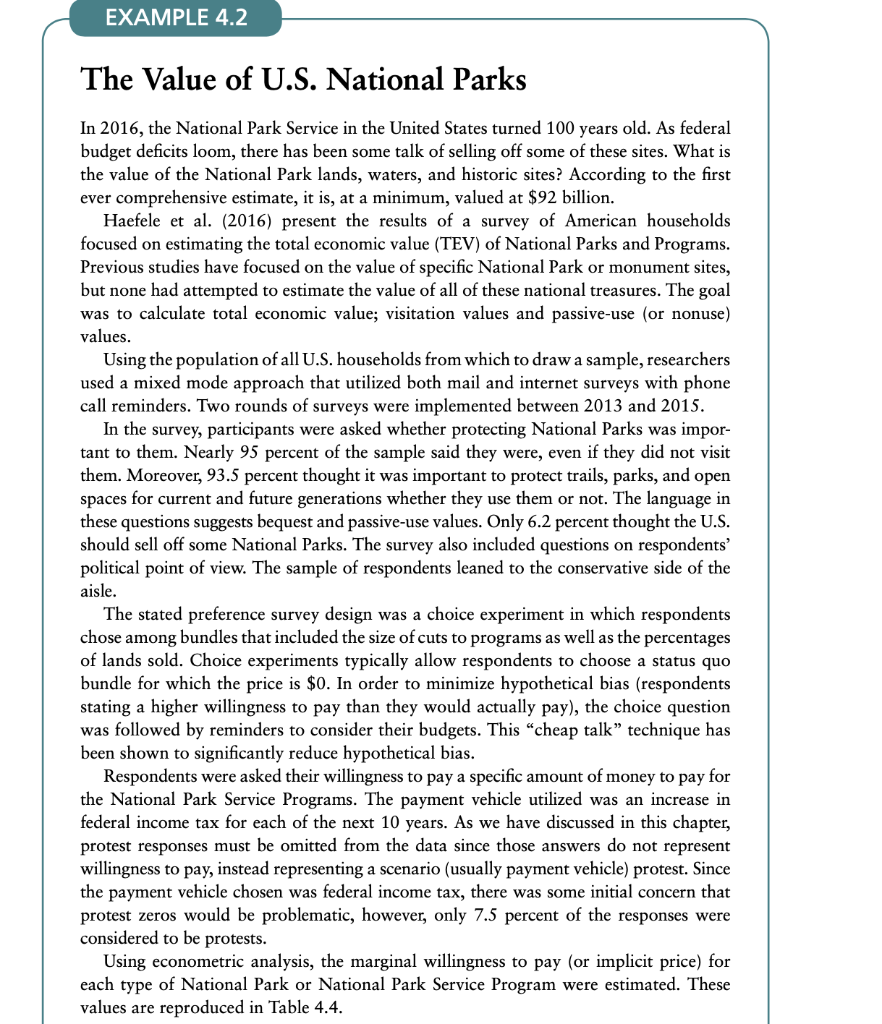
EXAMPLE 4.2 The Value of U.S. National Parks In 2016, the National Park Service in the United States turned 100 years old. As federal budget deficits loom, there has been some talk of selling off some of these sites. What is the value of the National Park lands, waters, and historic sites? According to the first ever comprehensive estimate, it is, at a minimum, valued at $92 billion. Haefele et al. (2016) present the results of a survey of American households focused on estimating the total economic value (TEV) of National Parks and Programs. Previous studies have focused on the value of specific National Park or monument sites, but none had attempted to estimate the value of all of these national treasures. The goal was to calculate total economic value; visitation values and passive-use (or nonuse) values. Using the population of all U.S. households from which to draw a sample, researchers used a mixed mode approach that utilized both mail and internet surveys with phone call reminders. Two rounds of surveys were implemented between 2013 and 2015. In the survey, participants were asked whether protecting National Parks was impor- tant to them. Nearly 95 percent of the sample said they were, even if they did not visit them. Moreover, 93.5 percent thought it was important to protect trails, parks, and open spaces for current and future generations whether they use them or not. The language in these questions suggests bequest and passive-use values. Only 6.2 percent thought the U.S. should sell off some National Parks. The survey also included questions on respondents' political point of view. The sample of respondents leaned to the conservative side of the aisle. The stated preference survey design was a choice experiment in which respondents chose among bundles that included the size of cuts to programs as well as the percentages of lands sold. Choice experiments typically allow respondents to choose a status quo bundle for which the price is $0. In order to minimize hypothetical bias (respondents stating a higher willingness to pay than they would actually pay), the choice question was followed by reminders to consider their budgets. This "cheap talk” technique has been shown to significantly reduce hypothetical bias. Respondents were asked their willingness to pay a specific amount of money to pay for the National Park Service Programs. The payment vehicle utilized was an increase in federal income tax for each of the next 10 years. As we have discussed in this chapter, protest responses must be omitted from the data since those answers do not represent willingness to pay, instead representing a scenario (usually payment vehicle) protest. Since the payment vehicle chosen was federal income tax, there was some initial concern that protest zeros would be problematic, however, only 7.5 percent of the responses were considered to be protests. Using econometric analysis, the marginal willingness to pay (or implicit price) for each type of National Park or National Park Service Program were estimated. These values are reproduced in Table 4.4.