Page 1 of 1
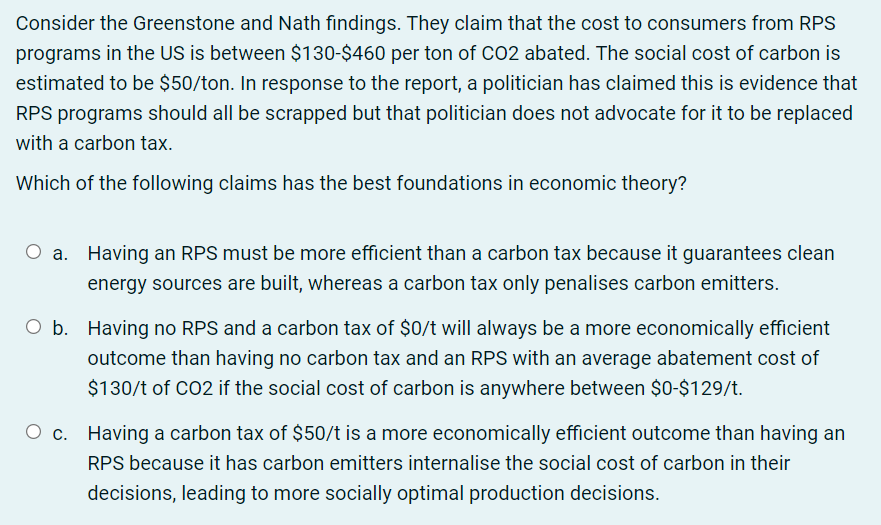
Consider the Greenstone and Nath findings. They claim that the cost to consumers from RPS programs in the US is between
Posted: Thu Apr 28, 2022 11:41 am
by answerhappygod
- Consider The Greenstone And Nath Findings They Claim That The Cost To Consumers From Rps Programs In The Us Is Between 1 (81.25 KiB) Viewed 55 times
Consider the Greenstone and Nath findings. They claim that the cost to consumers from RPS programs in the US is between $130-$460 per ton of CO2 abated. The social cost of carbon is estimated to be $50/ton. In response to the report, a politician has claimed this is evidence that RPS programs should all be scrapped but that politician does not advocate for it to be replaced with a carbon tax. Which of the following claims has the best foundations in economic theory? O a. Having an RPS must be more efficient than a carbon tax because it guarantees clean energy sources are built, whereas a carbon tax only penalises carbon emitters. Ob. O b. Having no RPS and a carbon tax of $0/t will always be a more economically efficient outcome than having no carbon tax and an RPS with an average abatement cost of $130/t of CO2 if the social cost of carbon is anywhere between $0-$129/t. O c. Having a carbon tax of $50/t is a more economically efficient outcome than having an RPS because it has carbon emitters internalise the social cost of carbon in their decisions, leading to more socially optimal production decisions.