Page 1 of 1
3. The sage cricket, Cyphoderris strepitans, has an unusual form of mating. During mating, the male offers his fleshy hi
Posted: Thu Apr 28, 2022 7:40 am
by answerhappygod
- 3 The Sage Cricket Cyphoderris Strepitans Has An Unusual Form Of Mating During Mating The Male Offers His Fleshy Hi 1 (58.92 KiB) Viewed 44 times
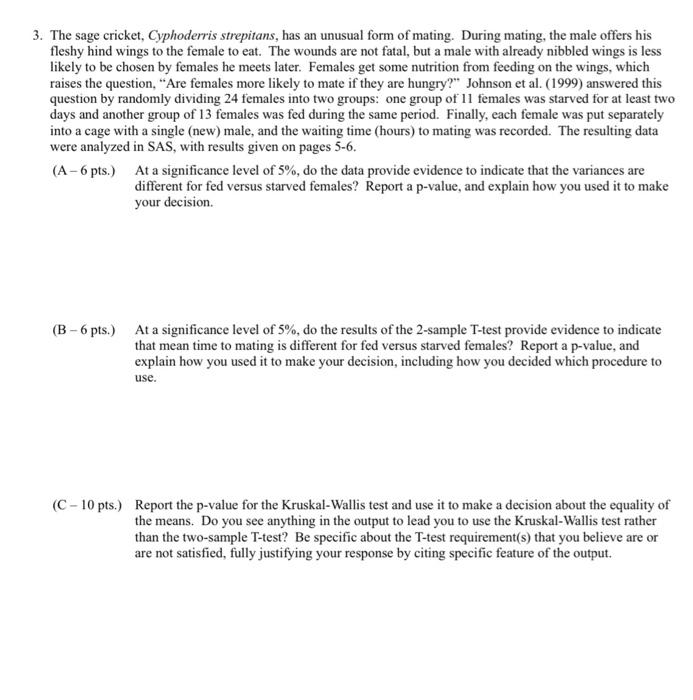
3. The sage cricket, Cyphoderris strepitans, has an unusual form of mating. During mating, the male offers his fleshy hind wings to the female to eat. The wounds are not fatal, but a male with already nibbled wings is less likely to be chosen by females he meets later. Females get some nutrition from feeding on the wings, which raises the question, "Are females more likely to mate if they are hungry?" Johnson et al. (1999) answered this question by randomly dividing 24 females into two groups: one group of 11 females was starved for at least two days and another group of 13 females was fed during the same period. Finally, each female was put separately into a cage with a single (new) male, and the waiting time (hours) to mating was recorded. The resulting data were analyzed in SAS, with results given on pages 5-6. (A - 6 pts.) At a significance level of 5%, do the data provide evidence to indicate that the variances are different for fed versus starved females? Report a p-value, and explain how you used it to make your decision (B-6 pts.) At a significance level of 5%, do the results of the 2-sample T-test provide evidence to indicate that mean time to mating is different for fed versus starved females? Report a p-value, and explain how you used it to make your decision, including how you decided which procedure to use. (C-10 pts.) Report the p-value for the Kruskal-Wallis test and use it to make a decision about the equality of the means. Do you see anything in the output to lead you to use the Kruskal-Wallis test rather than the two-sample T-test? Be specific about the T-test requirement(s) that you believe are or are not satisfied, fully justifying your response by citing specific feature of the output.