Page 1 of 1
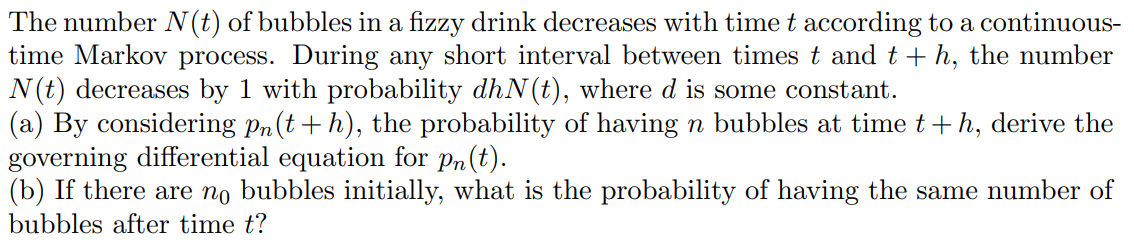
a The number N(t) of bubbles in a fizzy drink decreases with time t according to a continuous- time Markov process. Duri
Posted: Thu Apr 28, 2022 7:34 am
by answerhappygod
- A The Number N T Of Bubbles In A Fizzy Drink Decreases With Time T According To A Continuous Time Markov Process Duri 1 (95.58 KiB) Viewed 42 times
a The number N(t) of bubbles in a fizzy drink decreases with time t according to a continuous- time Markov process. During any short interval between times t and t + h, the number N(t) decreases by 1 with probability dhN(t), where d is some constant. (a) By considering Pn(t+h), the probability of having n bubbles at time t+h, derive the governing differential equation for Pn(t). (b) If there are no bubbles initially, what is the probability of having the same number of bubbles after time t?