- Polymerase Chain Reaction Pcr Is A Ubiquitous Technique In Molecular Genetics That Enables Researchers To Make A Huge 1 (84.47 KiB) Viewed 36 times
- Polymerase Chain Reaction Pcr Is A Ubiquitous Technique In Molecular Genetics That Enables Researchers To Make A Huge 2 (62.43 KiB) Viewed 36 times
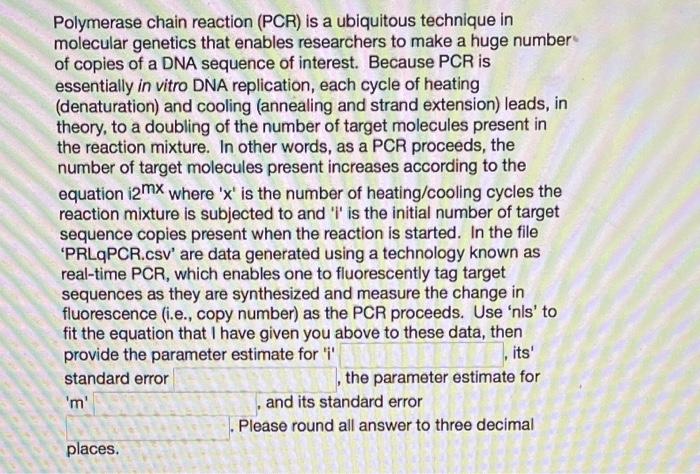
Polymerase chain reaction (PCR) is a ubiquitous technique in molecular genetics that enables researchers to make a huge number of copies of a DNA sequence of interest. Because PCR is essentially in vitro DNA replication, each cycle of heating (denaturation) and cooling (annealing and strand extension) leads, in theory, to a doubling of the number of target molecules present in the reaction mixture. In other words, as a PCR proceeds, the number of target molecules present increases according to the equation i2mx where 'x' is the number of heating/cooling cycles the reaction mixture is subjected to and 'l' is the initial number of target sequence copies present when the reaction is started. In the file PRLqPCR.csv' are data generated using a technology known as real-time PCR, which enables one to fluorescently tag target sequences as they are synthesized and measure the change in fluorescence (i.e., copy number) as the PCR proceeds. Use 'nls' to fit the equation that I have given you above to these data, then provide the parameter estimate for 'i' its' standard error the parameter estimate for 'm and its standard error . Please round all answer to three decimal places.
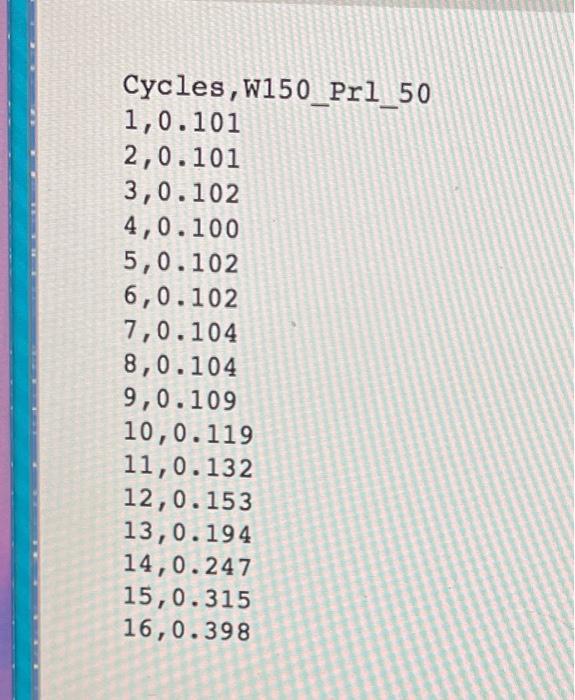
Cycles,W150_Prl_50 1,0.101 2,0.101 3,0.102 4,0.100 5,0.102 6,0.102 7,0.104 8,0.104 9,0.109 10,0.119 11,0.132 12,0.153 13,0.194 14,0.247 15,0.315 16,0.398