Page 1 of 1
1. A frictionless double piston-cylinder device contains 0.01 kg of air in Subsystem A and 0.002 kg of water liquid-vapo
Posted: Wed Apr 27, 2022 8:13 pm
by answerhappygod
- 1 A Frictionless Double Piston Cylinder Device Contains 0 01 Kg Of Air In Subsystem A And 0 002 Kg Of Water Liquid Vapo 1 (70.76 KiB) Viewed 39 times
- 1 A Frictionless Double Piston Cylinder Device Contains 0 01 Kg Of Air In Subsystem A And 0 002 Kg Of Water Liquid Vapo 2 (29.9 KiB) Viewed 39 times
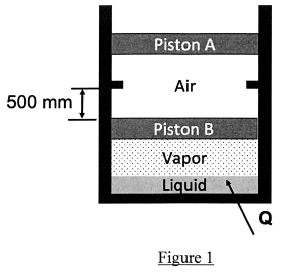
1. A frictionless double piston-cylinder device contains 0.01 kg of air in Subsystem A and 0.002 kg of water liquid-vapor mixture in Subsystem B. The quality of the liquid-vapor mixture is 40%. The masses of Piston A and Piston B are 2 kg and 3 kg, respectively. Both pistons have a cross-sectional area of 19.6 cm². The locations of the pistons at the initial state are shown in Figure 1. Heat is then added to the device with a heat source of Q. Both pistons move upwards and the final pressure in Subsystem B is found to be 200 kPa. Assume that Subsystems A and B are always in thermal equilibrium, and the air can be treated as an ideal gas with R=0.287 kJ/kg K. The local atmospheric pressure is 100 kPa. (a) Calculate the temperature of the device, the volume of the air in Subsystem A, and the volume of water in gaseous phase in Subsystem B at the initial state; (9 marks) (b) Calculate the temperature of the device, and the volume of the air in Subsystem A at the final state; (6 marks) (c) Calculate the work done by Subsystem B from the initial state to final state; (5 marks) (d) Calculate the amount of heat, Q, added to the device to reach the final state. (10 marks)
Piston A Air 500 mm] Piston B Vapor Liquid Figure 1