Page 1 of 1
a (a) (b) TEMPERATURE.(C) - 200 -100 300 10" IDEAL SHEAR STRESS 10 -C PURE ALUMINIUM d. 10 m PLASTICITY 10% DYNAMIC RECR
Posted: Wed Apr 27, 2022 7:40 pm
by answerhappygod
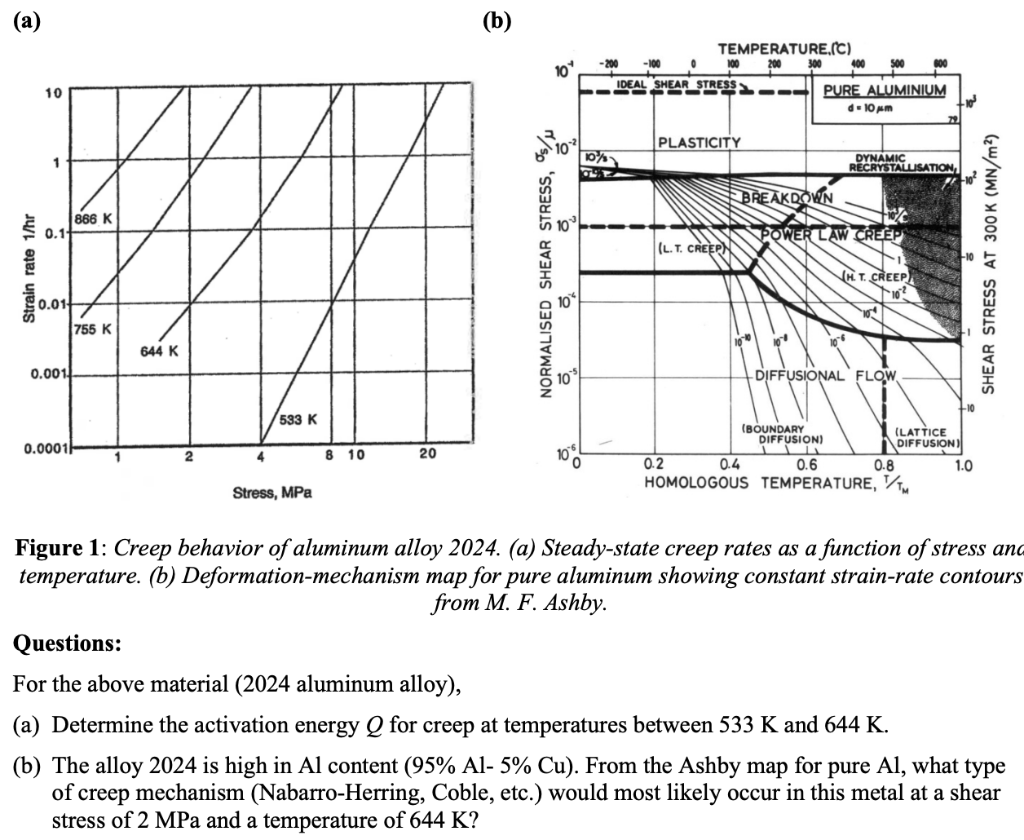
- A A B Temperature C 200 100 300 10 Ideal Shear Stress 10 C Pure Aluminium D 10 M Plasticity 10 Dynamic Recr 1 (348.13 KiB) Viewed 19 times
a (a) (b) TEMPERATURE.(C) - 200 -100 300 10" IDEAL SHEAR STRESS 10 -C PURE ALUMINIUM d. 10 m PLASTICITY 10% DYNAMIC RECRYSTALLISATION - BREAKDOWN 866 K 0.1 POWER LAW CREEP (L.T. CREEPN Strain rate 1/hr NORMALISED SHEAR STRESS, Osu SHEAR STRESS AT 300 K (MN/m2) (HT CREEP) 102 0.01 755 K 644 K 0.001 DIFFUSIONAL FLOW 533 K 0.00011 1 2 4 8 10 20 (BOUNDARY ILATTICE DIFFUSION) DIFFUSION) LL 0.2 0.4 0.6 0.8 1.0 HOMOLOGOUS TEMPERATURE, Stress, MPa Figure 1: Creep behavior of aluminum alloy 2024. (a) Steady-state creep rates as a function of stress and temperature. (b) Deformation-mechanism map for pure aluminum showing constant strain-rate contours from M. F. Ashby. Questions: For the above material (2024 aluminum alloy), (a) Determine the activation energy Q for creep at temperatures between 533 K and 644 K. (b) The alloy 2024 is high in Al content (95% Al- 5% Cu). From the Ashby map for pure Al, what type of creep mechanism (Nabarro-Herring, Coble, etc.) would most likely occur in this metal at a shear stress of 2 MPa and a temperature of 644 K?