Page 1 of 1
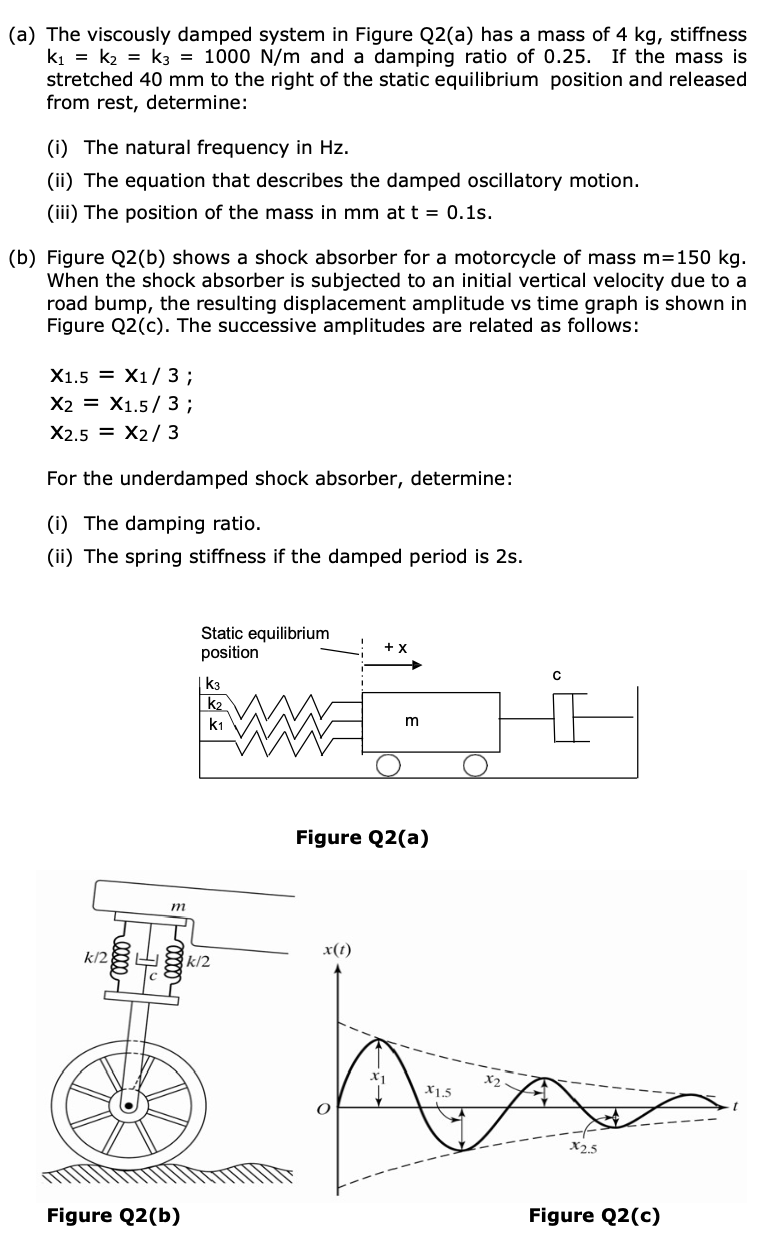
(a) The viscously damped system in Figure Q2(a) has a mass of 4 kg, stiffness kı = K2 = k3 = 1000 N/m and a damping rati
Posted: Wed Apr 27, 2022 7:36 pm
by answerhappygod
- A The Viscously Damped System In Figure Q2 A Has A Mass Of 4 Kg Stiffness Ki K2 K3 1000 N M And A Damping Rati 1 (166.98 KiB) Viewed 38 times
(a) The viscously damped system in Figure Q2(a) has a mass of 4 kg, stiffness kı = K2 = k3 = 1000 N/m and a damping ratio of 0.25. If the mass is stretched 40 mm to the right of the static equilibrium position and released from rest, determine: (i) The natural frequency in Hz. (ii) The equation that describes the damped oscillatory motion. (iii) The position of the mass in mm at t = 0.1s. (b) Figure Q2(b) shows a shock absorber for a motorcycle of mass m=150 kg. When the shock absorber is subjected to an initial vertical velocity due to a road bump, the resulting displacement amplitude vs time graph is shown in Figure Q2(c). The successive amplitudes are related as follows: X1.5 = X1/3; X2 = X1.5/3; X2.5 = X2/3 For the underdamped shock absorber, determine: (i) The damping ratio. (ii) The spring stiffness if the damped period is 2s. Static equilibrium position + X с k3 k1 m Figure Q2(a) m x(0) k/2 k/2 X1.5 X 2.5 Figure Q2(b) Figure Q2(c)