Page 1 of 1
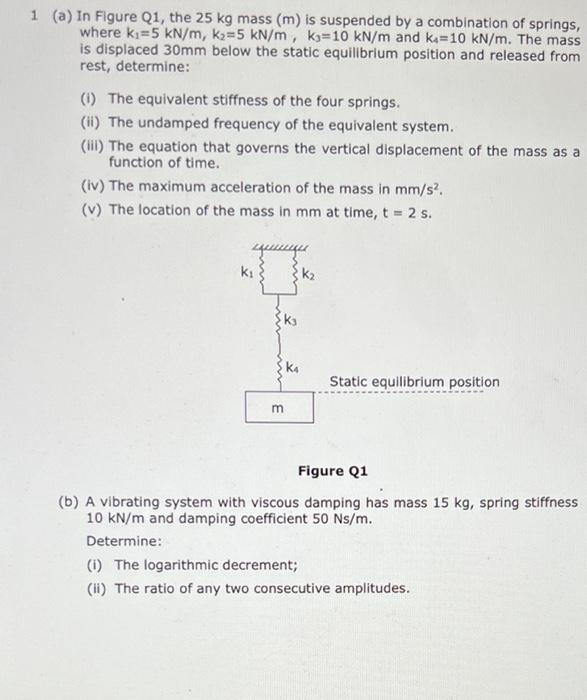
1 (a) in Figure Q1, the 25 kg mass (m) is suspended by a combination of springs, where kı=5 kN/m, K2=5 kN/m, k3=10 kN/m
Posted: Wed Apr 27, 2022 7:34 pm
by answerhappygod
- 1 A In Figure Q1 The 25 Kg Mass M Is Suspended By A Combination Of Springs Where Ki 5 Kn M K2 5 Kn M K3 10 Kn M 1 (44.76 KiB) Viewed 40 times
1 (a) in Figure Q1, the 25 kg mass (m) is suspended by a combination of springs, where kı=5 kN/m, K2=5 kN/m, k3=10 kN/m and ku=10 kN/m. The mass is displaced 30mm below the static equilibrium position and released from rest, determine: (1) The equivalent stiffness of the four springs. (ii) The undamped frequency of the equivalent system. (III) The equation that governs the vertical displacement of the mass as a function of time. (iv) The maximum acceleration of the mass in mm/s?. (v) The location of the mass in mm at time, t = 2 s. ki Ske ka Static equilibrium position m Figure Q1 (b) A vibrating system with viscous damping has mass 15 kg, spring stiffness 10 kN/m and damping coefficient 50 Ns/m. Determine: 1) The logarithmic decrement; (11) The ratio of any two consecutive amplitudes.