Page 1 of 1
GEOPHYSICAL WELL LOGGING オーバー STUDY EXERCISES value for porosity that you would expect to cal- culate for this rock by m
Posted: Wed Apr 27, 2022 7:32 pm
by answerhappygod
- 1 (165.02 KiB) Viewed 60 times
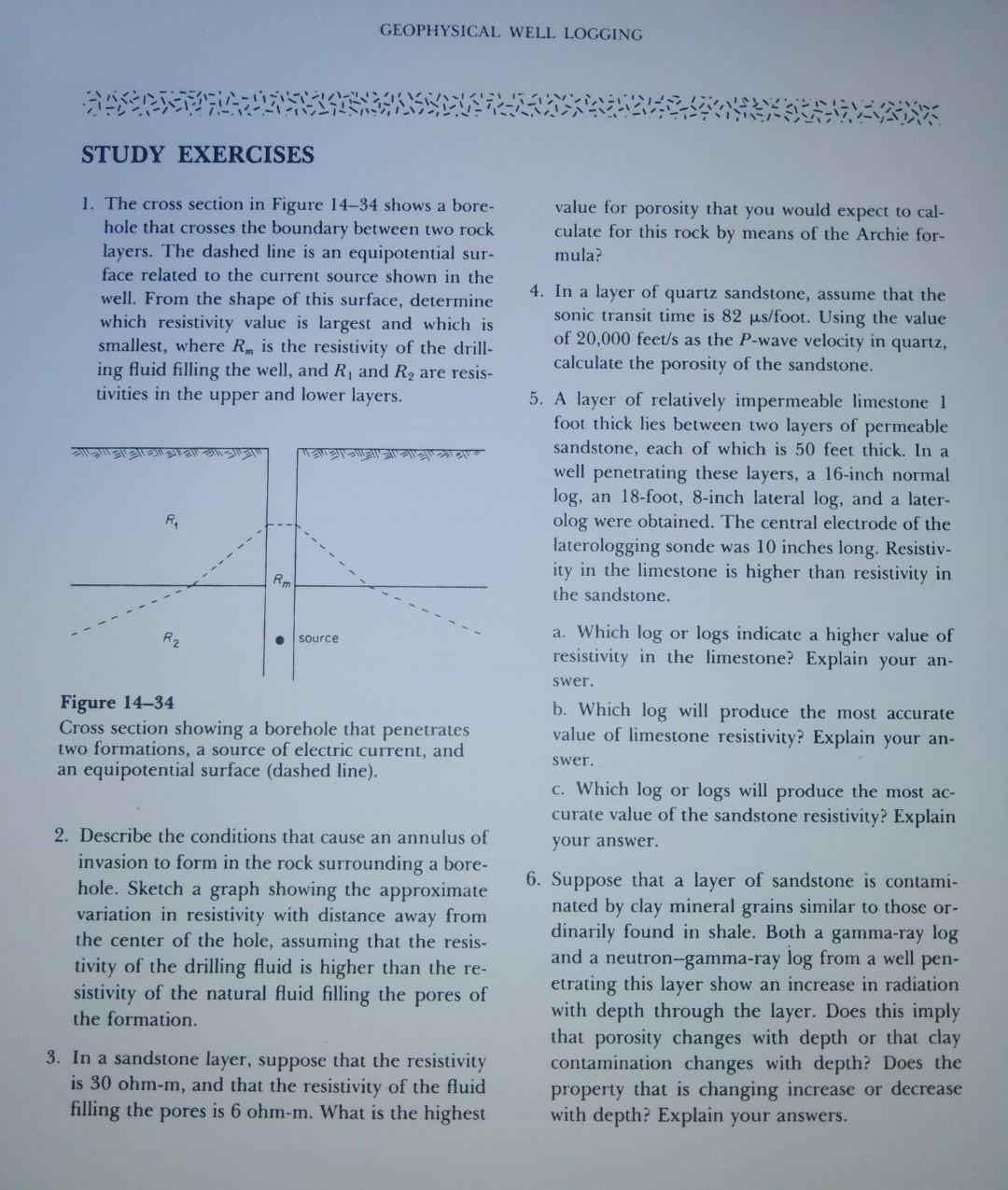
GEOPHYSICAL WELL LOGGING オーバー STUDY EXERCISES value for porosity that you would expect to cal- culate for this rock by means of the Archie for- mula? 1. The cross section in Figure 14-34 shows a bore- hole that crosses the boundary between two rock layers. The dashed line is an equipotential sur- face related to the current source shown in the well. From the shape of this surface, determine which resistivity value is largest and which is smallest, where R, is the resistivity of the drill- ing fluid filling the well, and R, and R, are resis- tivities in the upper and lower layers. 4. In a layer of quartz sandstone, assume that the sonic transit time is 82 ps/foot. Using the value of 20,000 feet/s as the P-wave velocity in quartz, calculate the porosity of the sandstone. 5. A layer of relatively impermeable limestone 1 foot thick lies between two layers of permeable sandstone, each of which is 50 feet thick. In a well penetrating these layers, a 16-inch normal log, an 18-foot, 8-inch lateral log, and a later- olog were obtained. The central electrode of the laterologging sonde was 10 inches long. Resistiv- ity in the limestone is higher than resistivity in the sandstone. 2 आप्त्रात्रा RE Am R2 source a. Which log or logs indicate a higher value of resistivity in the limestone? Explain your an- swer. Figure 14–34 Cross section showing a borehole that penetrates two formations, a source of electric current, and an equipotential surface (dashed line). 2. Describe the conditions that cause an annulus of invasion to form in the rock surrounding a bore- hole. Sketch a graph showing the approximate variation in resistivity with distance away from the center of the hole, assuming that the resis- tivity of the drilling fluid is higher than the re- sistivity of the natural fluid filling the pores of the formation. b. Which log will produce the most accurate value of limestone resistivity? Explain your an- swer. c. Which log or logs will produce the most ac- curate value of the sandstone resistivity? Explain your answer. 6. Suppose that a layer of sandstone is contami- nated by clay mineral grains similar to those or- dinarily found in shale. Both a gamma-ray log and a neutron-gamma-ray log from a well pen- etrating this layer show an increase in radiation with depth through the layer. Does this imply that porosity changes with depth or that clay contamination changes with depth? Does the property that is changing increase or decrease with depth? Explain your answers. 3. In a sandstone layer, suppose that the resistivity is 30 ohm-m, and that the resistivity of the fluid filling the pores is 6 ohm-m. What is the highest