Page 1 of 1
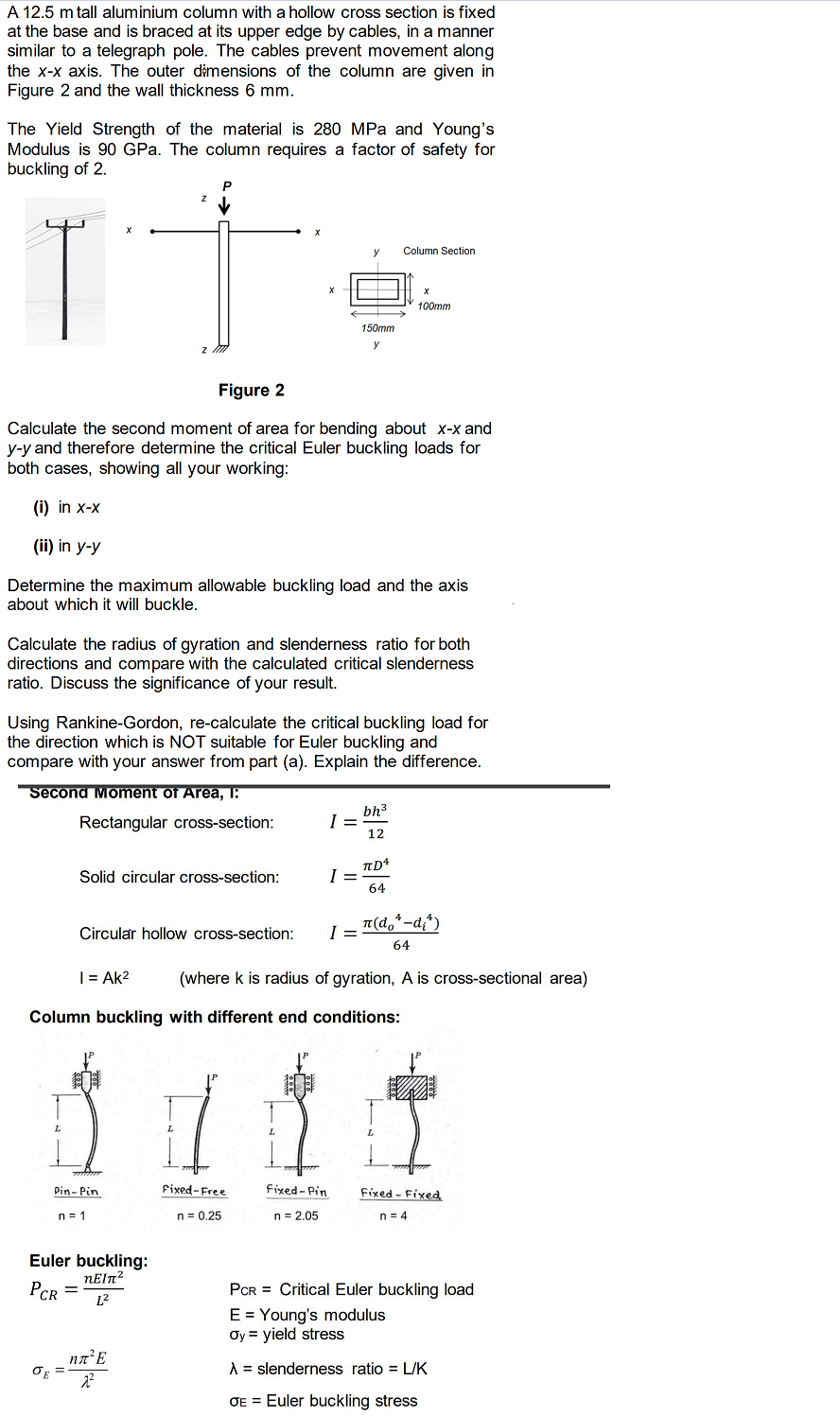
A 12.5 m tall aluminium column with a hollow cross section is fixed at the base and is braced at its upper edge by cable
Posted: Wed Apr 27, 2022 7:29 pm
by answerhappygod
- A 12 5 M Tall Aluminium Column With A Hollow Cross Section Is Fixed At The Base And Is Braced At Its Upper Edge By Cable 1 (334.76 KiB) Viewed 42 times
A 12.5 m tall aluminium column with a hollow cross section is fixed at the base and is braced at its upper edge by cables, in a manner similar to a telegraph pole. The cables prevent movement along the x-x axis. The outer dimensions of the column are given in Figure 2 and the wall thickness 6 mm. The Yield Strength of the material is 280 MPa and Young's Modulus is 90 GPa. The column requires a factor of safety for buckling of 2 Р Z LA у y Column Section 100mm 150mm y Figure 2 Calculate the second moment of area for bending about x-x and y-y and therefore determine the critical Euler buckling loads for both cases, showing all your working: (i) in x-x (ii) in y-y Determine the maximum allowable buckling load and the axis about which it will buckle. Calculate the radius of gyration and slenderness ratio for both directions and compare with the calculated critical slenderness ratio. Discuss the significance of your result. Using Rankine-Gordon, re-calculate the critical buckling load for the direction which is NOT suitable for Euler buckling and compare with your answer from part (a). Explain the difference. Second Moment of Area, 19 Rectangular cross-section: bh3 1 = 12 = TD4 Solid circular cross-section: I = 64 4 Circular hollow cross-section: I = T(d.-di) 64 | = Ak2 (where k is radius of gyration, A is cross-sectional area) Column buckling with different end conditions: L L L AT 77 Pin-Pin Fixed - Free Fixed - Pin fixed - Fixed n = 1 n n = 0.25 n = 2.05 n = 4 Euler buckling: nein PcR = L2 PCR = Critical Euler buckling load E = Young's modulus Oy = yield stress ηπ?Ε 0= CE 2 = slenderness ratio = L/K DE = Euler buckling stress