Page 1 of 1
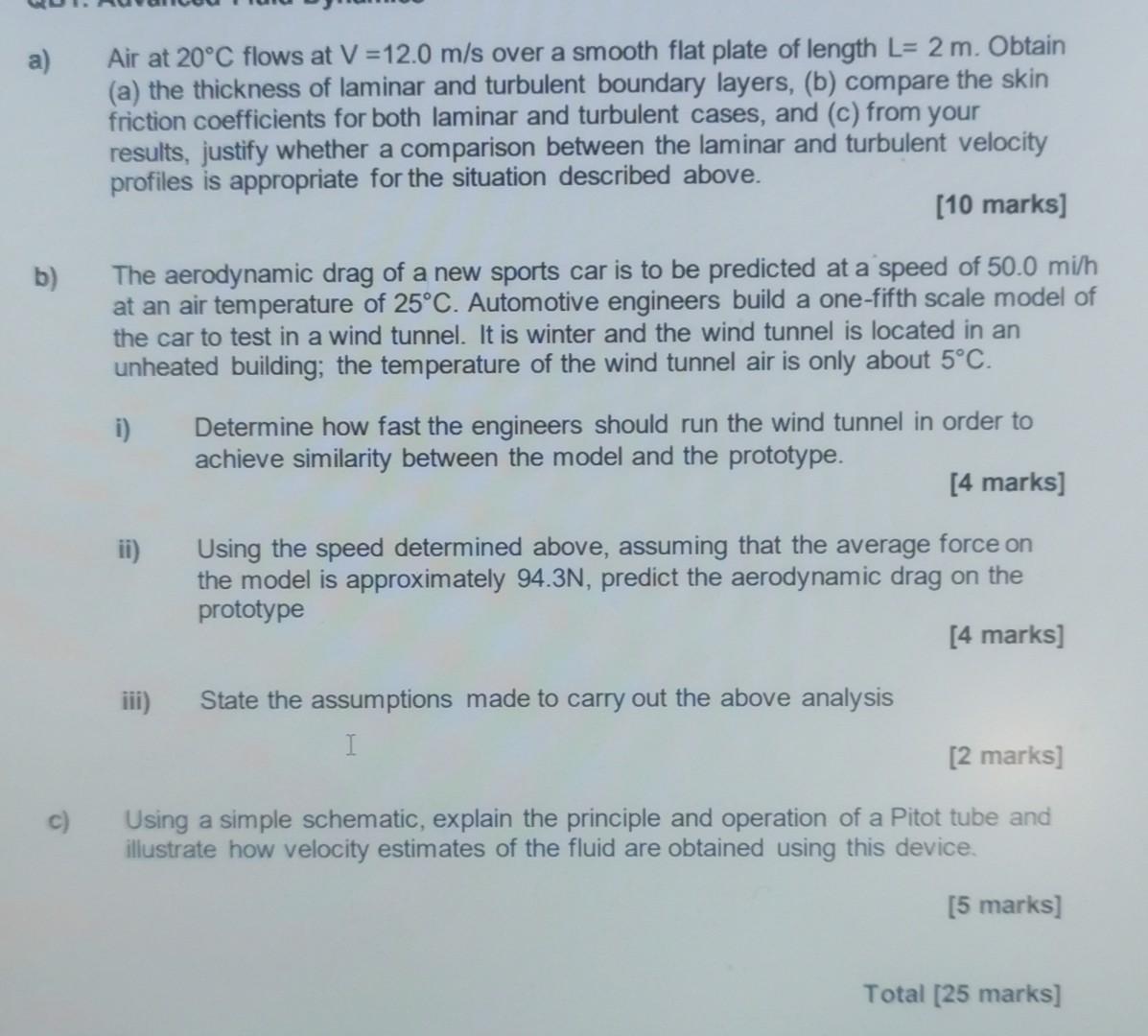
a) Air at 20°C flows at V =12.0 m/s over a smooth flat plate of length L= 2 m. Obtain (a) the thickness of laminar and t
Posted: Wed Apr 27, 2022 7:28 pm
by answerhappygod
- A Air At 20 C Flows At V 12 0 M S Over A Smooth Flat Plate Of Length L 2 M Obtain A The Thickness Of Laminar And T 1 (104.05 KiB) Viewed 33 times
a) Air at 20°C flows at V =12.0 m/s over a smooth flat plate of length L= 2 m. Obtain (a) the thickness of laminar and turbulent boundary layers, (b) compare the skin friction coefficients for both laminar and turbulent cases, and (c) from your results, justify whether a comparison between the laminar and turbulent velocity profiles is appropriate for the situation described above. [10 marks] b) The aerodynamic drag of a new sports car is to be predicted at a speed of 50.0 mi/h at an air temperature of 25°C. Automotive engineers build a one-fifth scale model of the car to test in a wind tunnel. It is winter and the wind tunnel is located in an unheated building; the temperature of the wind tunnel air is only about 5°C. Determine how fast the engineers should run the wind tunnel in order to achieve similarity between the model and the prototype. [4 marks] ii) Using the speed determined above, assuming that the average force on the model is approximately 94.3N, predict the aerodynamic drag on the prototype [4 marks] iii) State the assumptions made to carry out the above analysis I [2 marks] c) Using a simple schematic, explain the principle and operation of a Pitot tube and illustrate how velocity estimates of the fluid are obtained using this device. [5 marks] Total [25 marks]