Page 1 of 1
Problem 3. (6%) In our discussion on synchronised variants of AM, we have always been assum- ing perfect synchronisation
Posted: Wed Apr 27, 2022 6:04 pm
by answerhappygod
- Problem 3 6 In Our Discussion On Synchronised Variants Of Am We Have Always Been Assum Ing Perfect Synchronisation 1 (45.59 KiB) Viewed 21 times
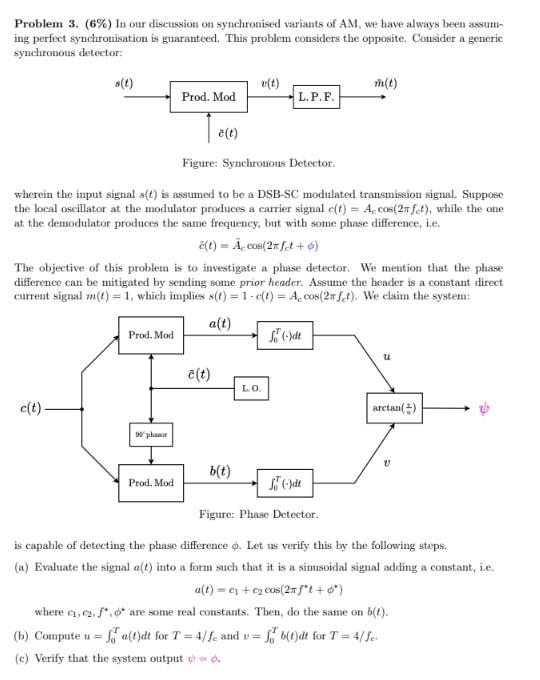
Problem 3. (6%) In our discussion on synchronised variants of AM, we have always been assum- ing perfect synchronisation is guaranteed. This problem considers the opposite. Consider a generic synchronous detector: 8(t) u(t) m(t) Prod. Mod L.P.F. e(t) Figure: Synchronous Detector. wherein the input signal (t) is assumed to be a DSB-SC modulated transmission sigml. Suppose the local oscillator at the modulator produces a carrier signale(t) = A CO(27fe!), while the one at the demodulator produces the same frequency, but with some phase difference, i.e. e(t) = A cos(25Ic4+) The objective of this problem is to investigate a phase detector. We mention that the phase difference can be mitigated by sending some prior header. Assume the header is a constant direct current signal m(t) = 1, which implies s() = 1.c() = A cos(2/2). We claim the system: a(t) Prod. Mod so (de c(t) LO c(t) arctan(

90 b(t) Prod. Mod đ (-dt Figure: Phase Detector. is capable of detecting the phase difference . Let us verify this by the following steps. (a) Evaluate the signal a(t) into a form such that it is a sinusoidal signal adding a constant, i.e. a(t) = 1 + 2 cos(2/*++*) where 0,03. are some real constants. Then, do the same on b(e). (b) Compute u = 3 alt}dt for T = 4/fe and v=) "(t)dt for T = 4/5 (e) Verify that the system output.