Page 1 of 1
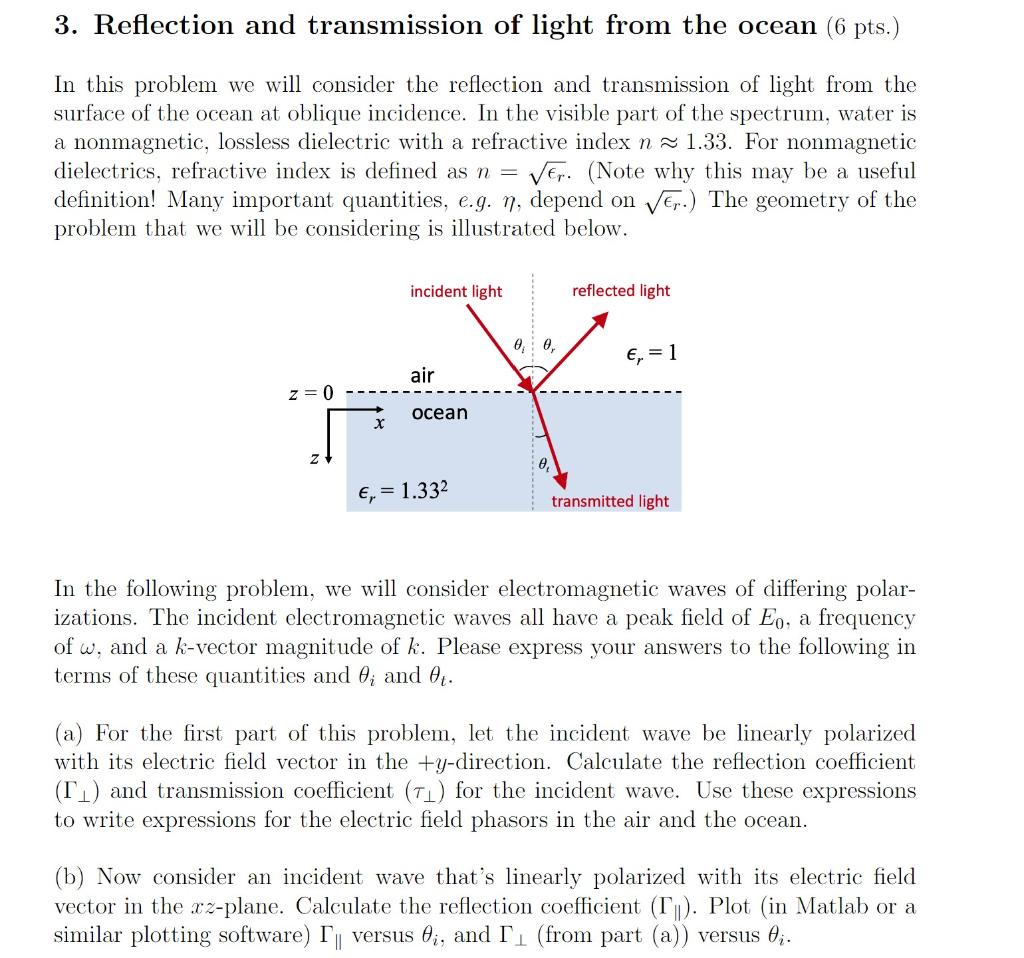
3. Reflection and transmission of light from the ocean (6 pts.) In this problem we will consider the reflection and tran
Posted: Wed Apr 27, 2022 5:58 pm
by answerhappygod
- 3 Reflection And Transmission Of Light From The Ocean 6 Pts In This Problem We Will Consider The Reflection And Tran 1 (142.7 KiB) Viewed 42 times
- 3 Reflection And Transmission Of Light From The Ocean 6 Pts In This Problem We Will Consider The Reflection And Tran 2 (110.86 KiB) Viewed 42 times
3. Reflection and transmission of light from the ocean (6 pts.) In this problem we will consider the reflection and transmission of light from the surface of the ocean at oblique incidence. In the visible part of the spectrum, water is a nonmagnetic, lossless dielectric with a refractive index n = 1.33. For nonmagnetic dielectrics, refractive index is defined as n = Ver. (Note why this may be a useful definition! Many important quantities, e.g. n, depend on vēr.) The geometry of the problem that we will be considering is illustrated below. incident light reflected light 0, 0, € = 1 air z=0 ocean €, = 1.332 transmitted light In the following problem, we will consider electromagnetic waves of differing polar- izations. The incident electromagnetic waves all have a peak field of Eo, a frequency of w, and a k-vector magnitude of k. Please express your answers to the following in terms of these quantities and 0; and 0t. (a) For the first part of this problem, let the incident wave be linearly polarized with its electric field vector in the +y-direction. Calculate the reflection coefficient (T2) and transmission coefficient (71) for the incident wave. Use these expressions to write expressions for the electric field phasors in the air and the ocean. (b) Now consider an incident wave that's linearly polarized with its electric field vector in the x2-plane. Calculate the reflection coefficient (T.)). Plot (in Matlab or a similar plotting software) 1, versus 0;, and T(from part (a)) versus ;.
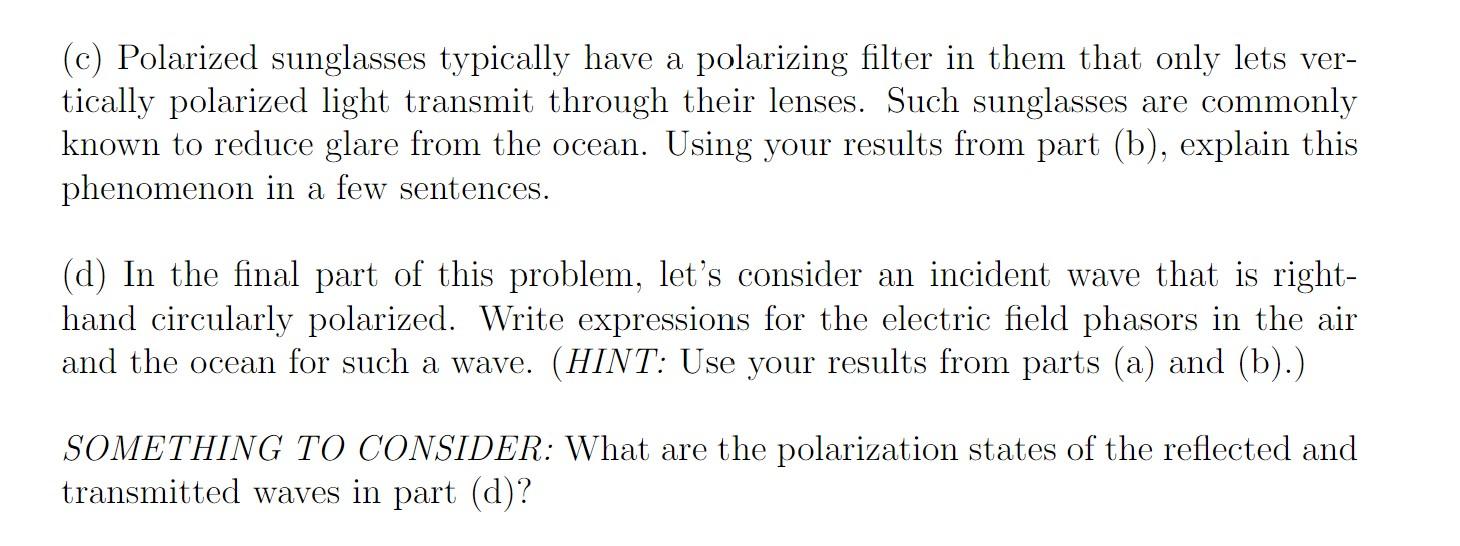
(c) Polarized sunglasses typically have a polarizing filter in them that only lets ver- tically polarized light transmit through their lenses. Such sunglasses are commonly known to reduce glare from the ocean. Using your results from part (b), explain this phenomenon in a few sentences. (d) In the final part of this problem, let's consider an incident wave that is right- hand circularly polarized. Write expressions for the electric field phasors in the air and the ocean for such a wave. (HINT: Use your results from parts (a) and (b).) SOMETHING TO CONSIDER: What are the polarization states of the reflected and transmitted waves in part (d)?