Page 1 of 1
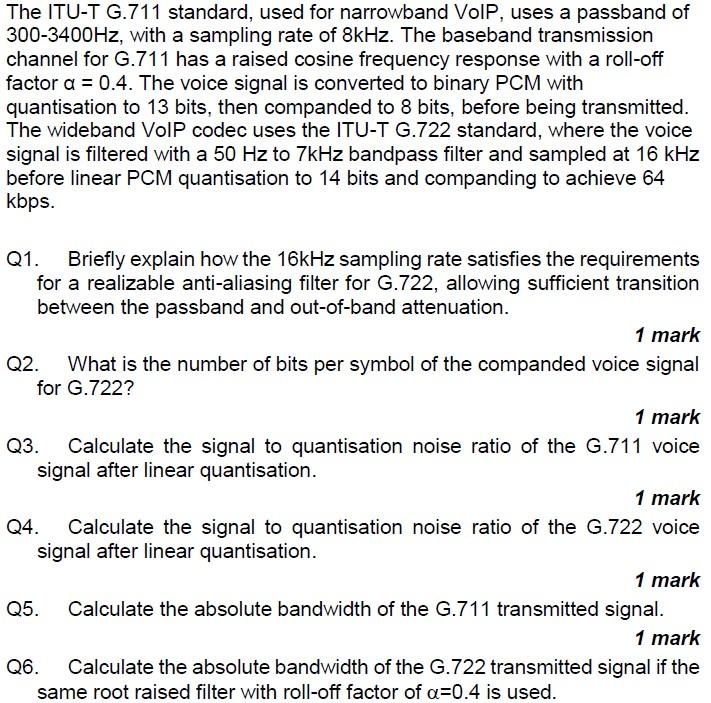
The ITU-T G.711 standard, used for narrowband VoIP, uses a passband of 300-3400Hz, with a sampling rate of 8kHz. The bas
Posted: Wed Apr 27, 2022 5:56 pm
by answerhappygod
- The Itu T G 711 Standard Used For Narrowband Voip Uses A Passband Of 300 3400hz With A Sampling Rate Of 8khz The Bas 1 (123.61 KiB) Viewed 54 times
The ITU-T G.711 standard, used for narrowband VoIP, uses a passband of 300-3400Hz, with a sampling rate of 8kHz. The baseband transmission channel for G.711 has a raised cosine frequency response with a roll-off factor a = 0.4. The voice signal is converted to binary PCM with quantisation to 13 bits, then companded to 8 bits, before being transmitted. The wideband VoIP codec uses the ITU-T G.722 standard, where the voice signal is filtered with a 50 Hz to 7kHz bandpass filter and sampled at 16 kHz before linear PCM quantisation to 14 bits and companding to achieve 64 kbps. Q1. Briefly explain how the 16kHz sampling rate satisfies the requirements for a realizable anti-aliasing filter for G.722, allowing sufficient transition between the passband and out-of-band attenuation. 1 mark Q2. What is the number of bits per symbol of the companded voice signal for G.722? 1 mark Q3. Calculate the signal to quantisation noise ratio of the G.711 voice signal after linear quantisation. 1 mark Q4. Calculate the signal to quantisation noise ratio of the G.722 voice signal after linear quantisation. 1 mark Q5. Calculate the absolute bandwidth of the G.711 transmitted signal. 1 mark Q6. Calculate the absolute bandwidth of the G.722 transmitted signal if the same root raised filter with roll-off factor of a=0.4 is used.