Page 1 of 1
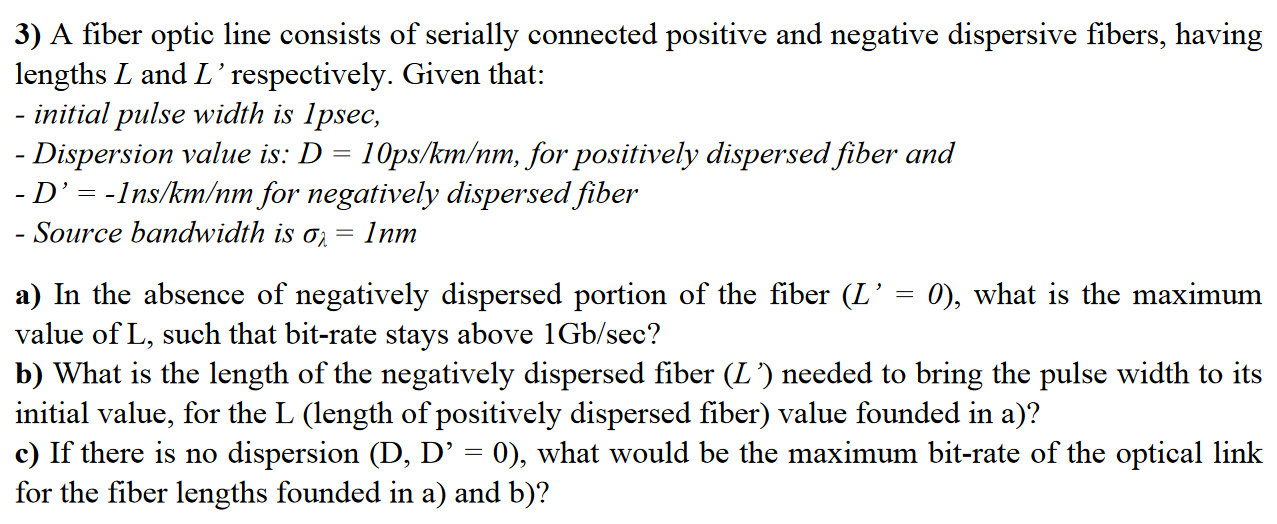
3) A fiber optic line consists of serially connected positive and negative dispersive fibers, having lengths L and L’res
Posted: Wed Apr 27, 2022 5:13 pm
by answerhappygod
- 3 A Fiber Optic Line Consists Of Serially Connected Positive And Negative Dispersive Fibers Having Lengths L And L Res 1 (82.42 KiB) Viewed 48 times
3) A fiber optic line consists of serially connected positive and negative dispersive fibers, having lengths L and L’respectively. Given that: - initial pulse width is lpsec, - Dispersion value is: D = 10ps/km/nm, for positively dispersed fiber and - D’=-1ns/km/nm for negatively dispersed fiber - Source bandwidth is on = Inm = = a) In the absence of negatively dispersed portion of the fiber (L' = 0), what is the maximum value of L, such that bit-rate stays above 1Gb/sec? b) What is the length of the negatively dispersed fiber (L') needed to bring the pulse width to its initial value, for the L (length of positively dispersed fiber) value founded in a)? c) If there is no dispersion (D, D' = 0), what would be the maximum bit-rate of the optical link for the fiber lengths founded in a) and b)?