Page 1 of 1
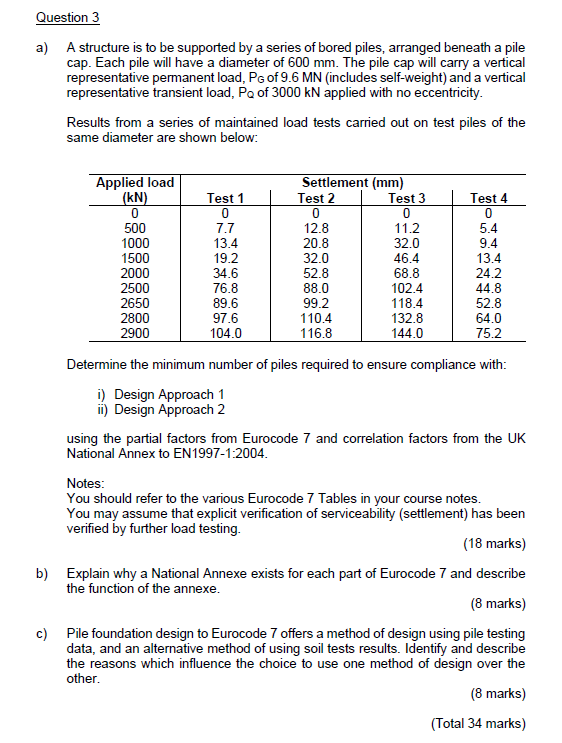
Question 3 a) A structure is to be supported by a series of bored piles, arranged beneath a pile cap. Each pile will hav
Posted: Wed Apr 27, 2022 2:52 pm
by answerhappygod
- Question 3 A A Structure Is To Be Supported By A Series Of Bored Piles Arranged Beneath A Pile Cap Each Pile Will Hav 1 (58.54 KiB) Viewed 51 times
Question 3 a) A structure is to be supported by a series of bored piles, arranged beneath a pile cap. Each pile will have a diameter of 600 mm. The pile cap will carry a vertical representative permanent load, Pa of 9.6 MN (includes self-weight) and a vertical representative transient load, Po of 3000 kN applied with no eccentricity. Results from a series of maintained load tests carried out on test piles of the same diameter are shown below: 20.8 மன் Applied load (kN) 0 500 1000 1500 2000 2500 2650 2800 2900 Test 1 0 7.7 13.4 19.2 34.6 76.8 89.6 97.6 104.0 Settlement (mm) Test 2 Test 3 0 0 12.8 11.2 32.0 32.0 46.4 52.8 68.8 88.0 102.4 99.2 118.4 110.4 132.8 116.8 144.0 Test 4 0 5.4 9.4 13.4 24.2 44.8 52.8 64.0 75.2 Determine the minimum number of piles required to ensure compliance with: i) Design Approach 1 ii) Design Approach 2 using the partial factors from Eurocode 7 and correlation factors from the UK National Annex to EN1997-1:2004. Notes: You should refer to the various Eurocode 7 Tables in your course notes. You may assume that explicit verification of serviceability (settlement) has been verified by further load testing. (18 marks) b) Explain why a National Annexe exists for each part of Eurocode 7 and describe the function of the annexe. (8 marks) c) Pile foundation design to Eurocode 7 offers a method of design using pile testing data, and an alternative method of using soil tests results. Identify and describe the reasons which influence the choice to use one method of design over the other. (8 marks) (Total 34 marks)