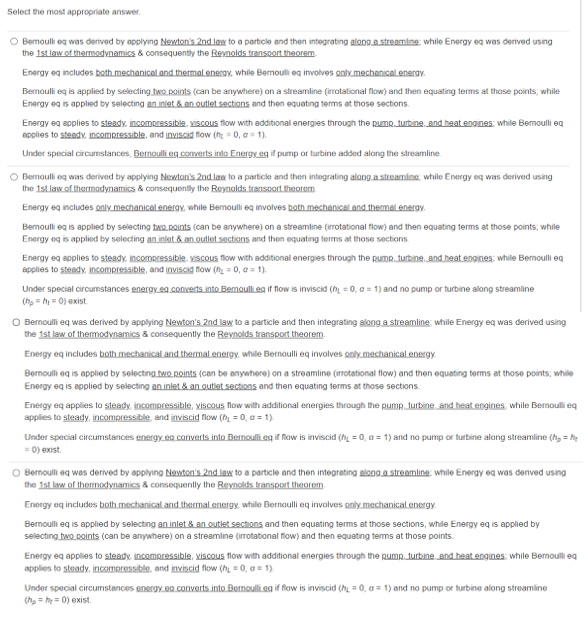
- Select The Most Appropriate Answer Bemoullie Was Derived By Applying Newton S 2nd Low To A Particle And Then Integrating 1 (274.97 KiB) Viewed 34 times
Select the most appropriate answer Bemoullie was derived by applying Newton's 2nd low to a particle and then integrating along a streamline while Energy was derived using the 1st law of thermodynamics & consequently the Reynolds transport theorem Energy eq includes both mechanical and thermal energy whilo Bemouli og involves only.mechanical energy Bemouli eq is applied by selecting two points (can be anywhere) on a streamline (irrotational flow) and then equating terms at those points, while Energy eq is applied by selecting an inlet & en outlet sections and then equating terms at those sections Energy eq applies to steady incompressible viscous flow with additional energies through the pump. turbing and heat engines: While Bemoullieq applies to steady incompressible, and inviscid flow or = 0,0 = 1). Under special circumstances, Bernoulli e converts into Energy eg if pump or turbine added along the streamline Bernoulli eq was derived by applying Newton's 2nd love to a partick and then integrating along a streaming while Energy eq was derived using the 1stlaw of thermodynamics & consequently the Reynolds transport theorem Energy eq includes only mechanical energy, while Bemoulle involves both mechanical and thermal energy Bernoull eg is applied by selecting two points (can be anywhere) on a streamline (irrotational flow) and then equating terms at those points, while Energy eq is applied by selecting an inlet & an outlet sections and then equating terms at those sections Energy eq applies to steady, incompressible viscous flow with additional energies through the Rum turbine and heat engines: While Bemouleg applies to steady, incompressible, and inviscid flow the = 0, 0 = 1). Under special circumstances energy...converts into Bemoull. eg if flow is inviscid h = 0, C = 1) and no pump or turbine along streamline (hạ = h = 0) ºxit. Bernoulli eg was derived by applying Newton's 2nd law to a particle and then integrating along a streamline while Energy eq was derived using the 1st few of themodynamics & consequently the Reynolds transport theorem Energy eq includes both mechanical and thermal energy, while Bernoulli e involves only mechanical energy Bernoulli eq is applied by selecting two points (can be anywhere) on a streamline (irrotational flow) and then equating terms at those points, while Energy eq is applied by selecting an inlet & an outlet sections and then equating terms at those sections. Energy eq applies to steady incompressible, viscous flow with additional energies through the pump turbine, and heat engines while Bemouli eq applies to steady, incompressible and inviscid flow (h = 0, 0 = 1) Under special circumstances energy-eg.converts into Bemoulli eg if now is inviscid (h_ = 0, a = 1) and no pump or turbine alang streamline (his = Me = 0) exist Bornoulli oq was derived by applying Nowton's 2nd low to a particle and then integrating along a stroomline: While Energy eq was derived using the 1st low of thermodynamics & consequently the Reynolds transport thearom Energy eq includes both mechanical and thermal energy, while Bernoulli eq involves only mechanical energy Bernoulli eq is applied by selecting an inlet & an outlet sections and then equating terms at those sections, while Energy eq is applied by selecting two points (can be anywhere) on a streamline (irrotational flow) and then equating terms at those points Energy eq applies to steady incompressible, viscous flow with additional energies through the pump, turbine and heat engines: while Bernoull eq applies to steady, incompressible and inviscid flow (h = 0, q = 1) Under special circumstances energy.ew.converts into Bernouliag if flow is inviscid (hı = 0, a = 1) and no pump or turbine along streamline 4. h = 0) Elist.