Page 1 of 1
a - > Consider a pure exchange economy, with two price-taking individuals (A and B) and two goods (1 and 2). The total e
Posted: Wed Apr 27, 2022 11:50 am
by answerhappygod
- A Consider A Pure Exchange Economy With Two Price Taking Individuals A And B And Two Goods 1 And 2 The Total E 1 (609.68 KiB) Viewed 35 times
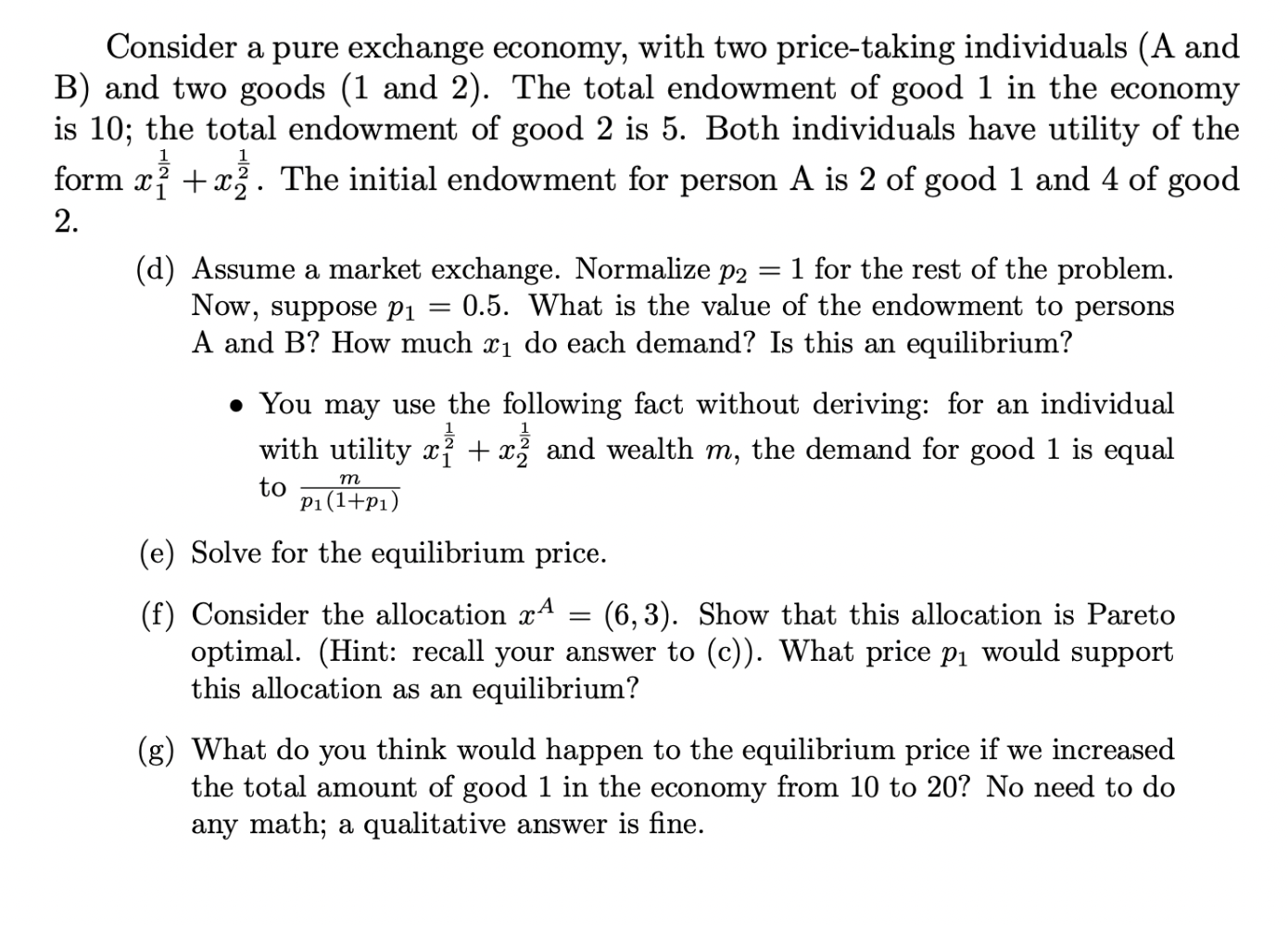
a - > Consider a pure exchange economy, with two price-taking individuals (A and B) and two goods (1 and 2). The total endowment of good 1 in the economy is 10; the total endowment of good 2 is 5. Both individuals have utility of the form x] + x2. The initial endowment for person A is 2 of good 1 and 4 of good 2. (d) Assume a market exchange. Normalize P2 1 for the rest of the problem. Now, suppose P1 0.5. What is the value of the endowment to persons A and B? How much xí do each demand? Is this an equilibrium? • You may use the following fact without deriving: for an individual with utility x] + x2 and wealth m, the demand for good 1 is equal p1 (e) Solve for the equilibrium price. (f) Consider the allocation xA (6,3). Show that this allocation is Pareto optimal. (Hint: recall your answer to (c)). What price pi would support this allocation as an equilibrium? m to pu(1+pi) = (g) What do you think would happen to the equilibrium price if we increased the total amount of good 1 in the economy from 10 to 20? No need to do any math; a qualitative answer is fine.