- 1 The Racoon Memory Chip Co Rmc For Short Instructs Its Resident Econometrician To Investigate The Operating Life O 1 (134.05 KiB) Viewed 38 times
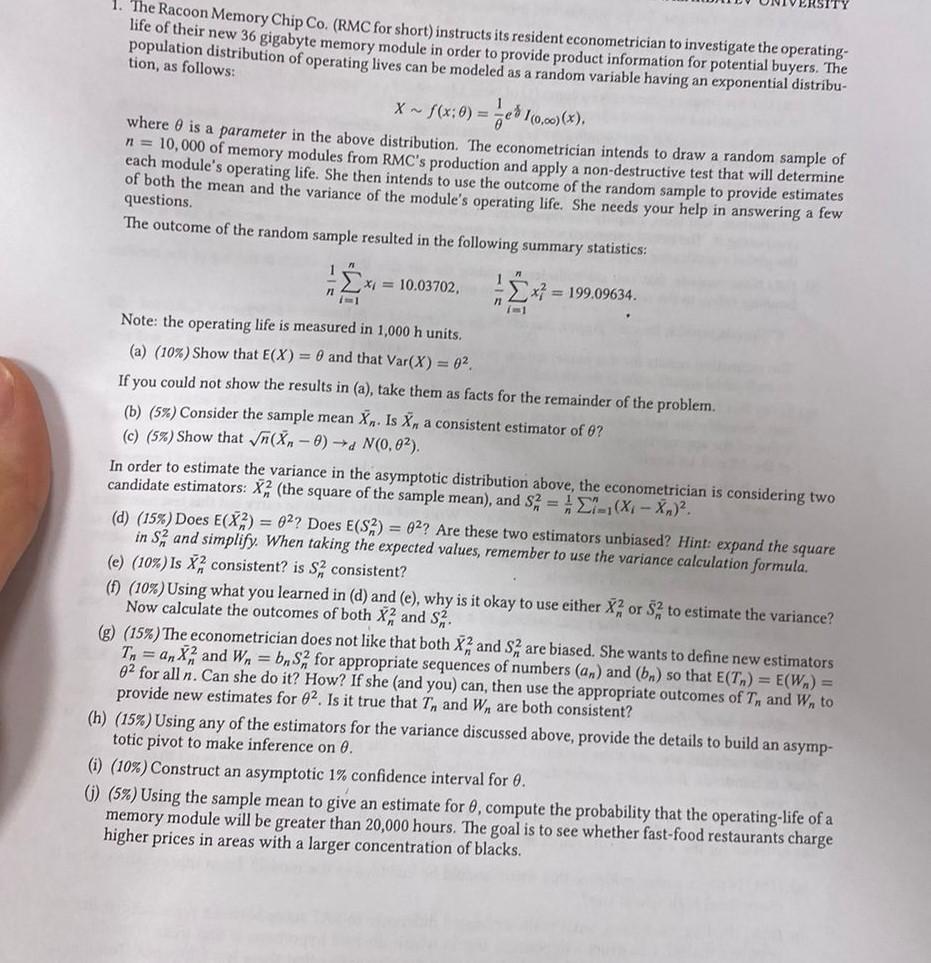
1. The Racoon Memory Chip Co. (RMC for short) instructs its resident econometrician to investigate the operating- life of their new 36 gigabyte memory module in order to provide product information for potential buyers. The population distribution of operating lives can be modeled as a random variable having an exponential distribu- tion, as follows: * ~ 5(x: 0) = bed 10.00)(x). where 0 is a parameter in the above distribution. The econometrician intends to draw a random sample of n = 10,000 of memory modules from RMC's production and apply a non-destructive test that will determine each module's operating life. She then intends to use the outcome of the random sample to provide estimates of both the mean and the variance of the module's operating life. She needs your help in answering a few questions The outcome of the random sample resulted in the following summary statistics: Σχι = 10.03702, { x = 199,09634. 1 11 Note: the operating life is measured in 1,000 h units. (a) (10%) Show that E(X) = 0 and that Var(X) = 02. If you could not show the results in (a), take them as facts for the remainder of the problem. (b) (5%) Consider the sample mean X, Is X, a consistent estimator of 0? (c) (5%) Show that (X-6) ► N(0.02). In order to estimate the variance in the asymptotic distribution above, the econometrician is considering two candidate estimators: X (the square of the sample mean), and S2 = 2 = (X-X.). (d) (15%) Does E(X) = 02? Does E(53) = 02? Are these two estimators unbiased? Hint: expand the square in S, and simplify. When taking the expected values, remember to use the variance calculation formula. (e) (10%) Is X; consistent? is S, consistent? (1) (10%) Using what you learned in (d) and (e), why is it okay to use either X or 53 to estimate the variance? Now calculate the outcomes of both X2 and 52. (g) (15%) The econometrician does not like that both X and S, are biased. She wants to define new estimators Tn = an X7 and Wn = bn 92 for appropriate sequences of numbers (an) and (bn) so that E(T.) = E(WA) = 02 for all n. Can she do it? How? If she (and you) can, then use the appropriate outcomes of T, and W, to provide new estimates for 62. Is it true that T, and Wn are both consistent? (h) (15%) Using any of the estimators for the variance discussed above, provide the details to build an asymp- totic pivot to make inference on 0. (i) (10%) Construct an asymptotic 1% confidence interval for 0. () (5%) Using the sample mean to give an estimate for 0, compute the probability that the operating-life of a memory module will be greater than 20,000 hours. The goal is to see whether fast-food restaurants charge higher prices in areas with a larger concentration of blacks.