Page 1 of 1
FRQ-Design an Experiment Some students want to know what gets "used up" in an incandescent lightbulb when it is in serie
Posted: Wed Apr 27, 2022 7:46 am
by answerhappygod
- Frq Design An Experiment Some Students Want To Know What Gets Used Up In An Incandescent Lightbulb When It Is In Serie 1 (77.02 KiB) Viewed 42 times
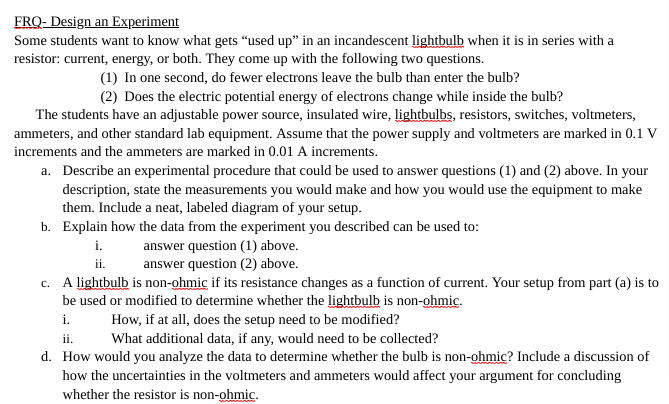
FRQ-Design an Experiment Some students want to know what gets "used up" in an incandescent lightbulb when it is in series with a resistor: current, energy, or both. They come up with the following two questions. (1) In one second, do fewer electrons leave the bulb than enter the bulb? (2) Does the electric potential energy of electrons change while inside the bulb? The students have an adjustable power source, insulated wire, lightbulbs, resistors, switches, voltmeters, ammeters, and other standard lab equipment. Assume that the power supply and voltmeters are marked in 0.1 V increments and the ammeters are marked in 0.01 A increments. a. Describe an experimental procedure that could be used to answer questions (1) and (2) above. In your description, state the measurements you would make and how you would use the equipment to make them. Include a neat, labeled diagram of your setup. b. Explain how the data from the experiment you described can be used to: i. answer question (1) above. ii. answer question (2) above. C. A lightbulb is non-ohmic if its resistance changes as a function of current. Your setup from part (a) is to be used or modified to determine whether the lightbulb is non-ohmic. i. How, if at all, does the setup need to be modified? ii. What additional data, if any, would need to be collected? d. How would you analyze the data to determine whether the bulb is non-ohmic? Include a discussion of how the uncertainties in the voltmeters and ammeters would affect your argument for concluding whether the resistor is non-ohmic.