- 1 (348.44 KiB) Viewed 29 times
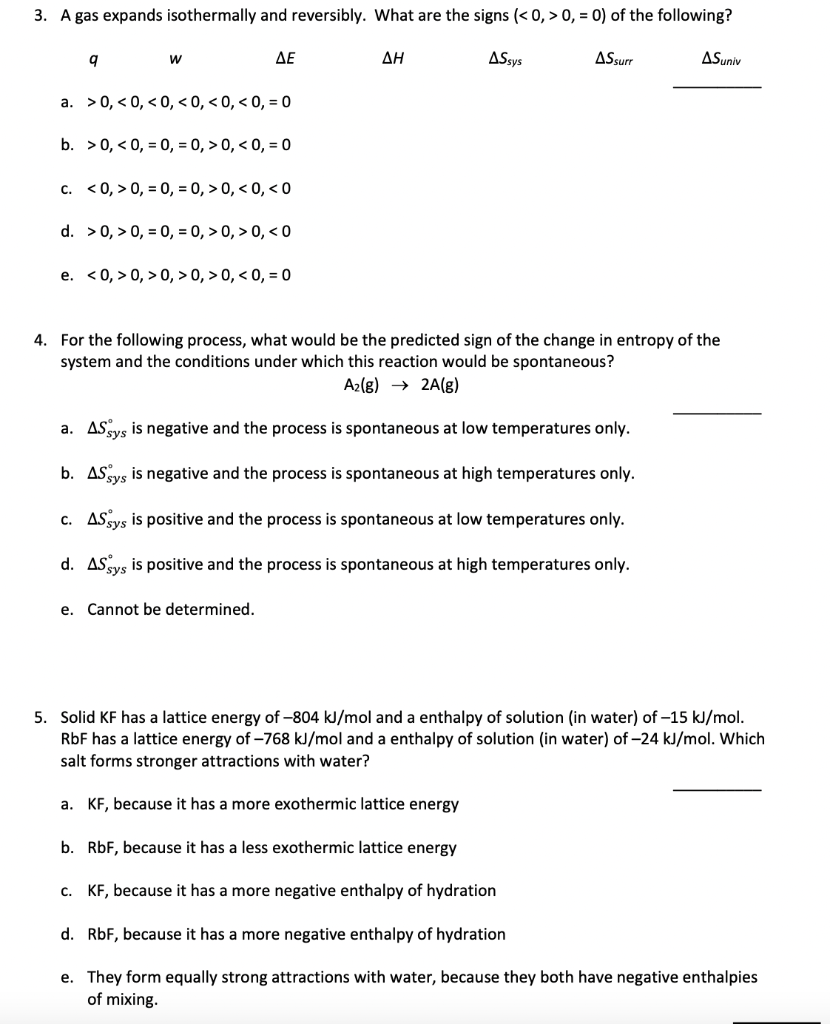
3. A gas expands isothermally and reversibly. What are the signs (< 0, 0, = 0) of the following? 9 w ΔΕ AH ASSY ASsurr ASuniv a. > 0, 0, 0, 0, 0, 0, = 0 b. >0,<0, = 0, = 0, 0, 0, = 0 c. <0, 0, = 0, = 0, 0, 0, < 0 d. > 0, > 0, = 0, = 0, 0, 0, < 0 e. <0, 0, 0, 0, 0, 0, = 0 4. For the following process, what would be the predicted sign of the change in entropy of the system and the conditions under which this reaction would be spontaneous? Az(g) + 2A(g) a. Assys is negative and the process is spontaneous at low temperatures only. b. Assys is negative and the process is spontaneous at high temperatures only. C. ASšys is positive and the process is spontaneous at low temperatures only. d. Asgys is positive and the process is spontaneous at high temperatures only. e. Cannot be determined. 5. Solid KF has a lattice energy of -804 kJ/mol and a enthalpy of solution (in water) of -15 kJ/mol. RbF has a lattice energy of -768 kJ/mol and a enthalpy of solution (in water) of -24 kJ/mol. Which salt forms stronger attractions with water? a. KF, because it has a more exothermic lattice energy b. RbF, because it has a less exothermic lattice energy C. KF, because it has a more negative enthalpy of hydration d. RbF, because it has a more negative enthalpy of hydration e. They form equally strong attractions with water, because they both have negative enthalpies of mixing.