Page 1 of 1
10.2 Parallel transport gauge: Consider a system subject to a weak adiabatic perturbation that is periodic in time. With
Posted: Tue Apr 26, 2022 8:54 pm
by answerhappygod
- 10 2 Parallel Transport Gauge Consider A System Subject To A Weak Adiabatic Perturbation That Is Periodic In Time With 1 (55.95 KiB) Viewed 24 times
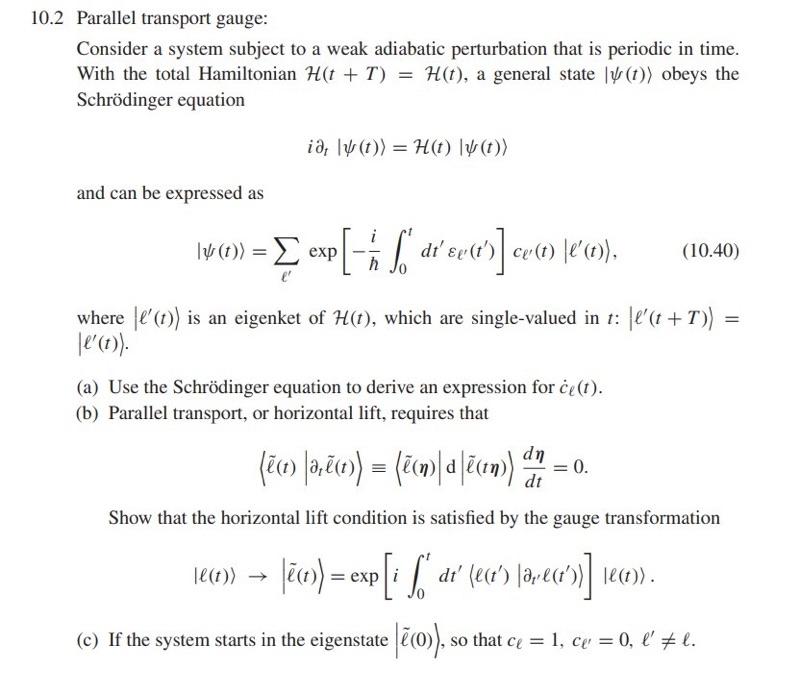
10.2 Parallel transport gauge: Consider a system subject to a weak adiabatic perturbation that is periodic in time. With the total Hamiltonian H(t + T) = H(t), a general state ly (1)) obeys the Schrödinger equation iar ly(t)) = H(t) ly(t)) and can be expressed as i lv ()) = exp[ + 5 di svuy]0) lºco), = (10.40) E where le' (t)) is an eigenket of H(t), which are single-valued in t: le'(t + 7)) le' (t)). (a) Use the Schrödinger equation to derive an expression for ċe(t). (b) Parallel transport, or horizontal lift, requires that (8) |a7m) = lēmlauw) Show that the horizontal lift condition is satisfied by the gauge transformation llt lem) – 1.0) = exp [i ſar ' (e(' area')] 1em). (c) If the system starts in the eigenstate |ēco)), so that cư = 1, cv = 0, l' #l. ce 0, dn = 0. dt dt
(i) Determine ce and ċe. Is the adiabatic theorem satisfied? (ii) Check if the ansatz solution lēr(t) fərēco) exp[ÁS 4 (620) =<««)] Ce(t) = -ih dt' - Elt El(t) - Ell(t) obeys the differential equation you obtained for ċe. (Neglect terms of second order). (iii) Write down an expression for the state function that includes the first-order approximation