- 58 3 Kelvin Helmholtz Instability 3 3 An Initial Value Problem For The Perturbation Of A Vortex Sheet Suppose That The 1 (180.05 KiB) Viewed 27 times
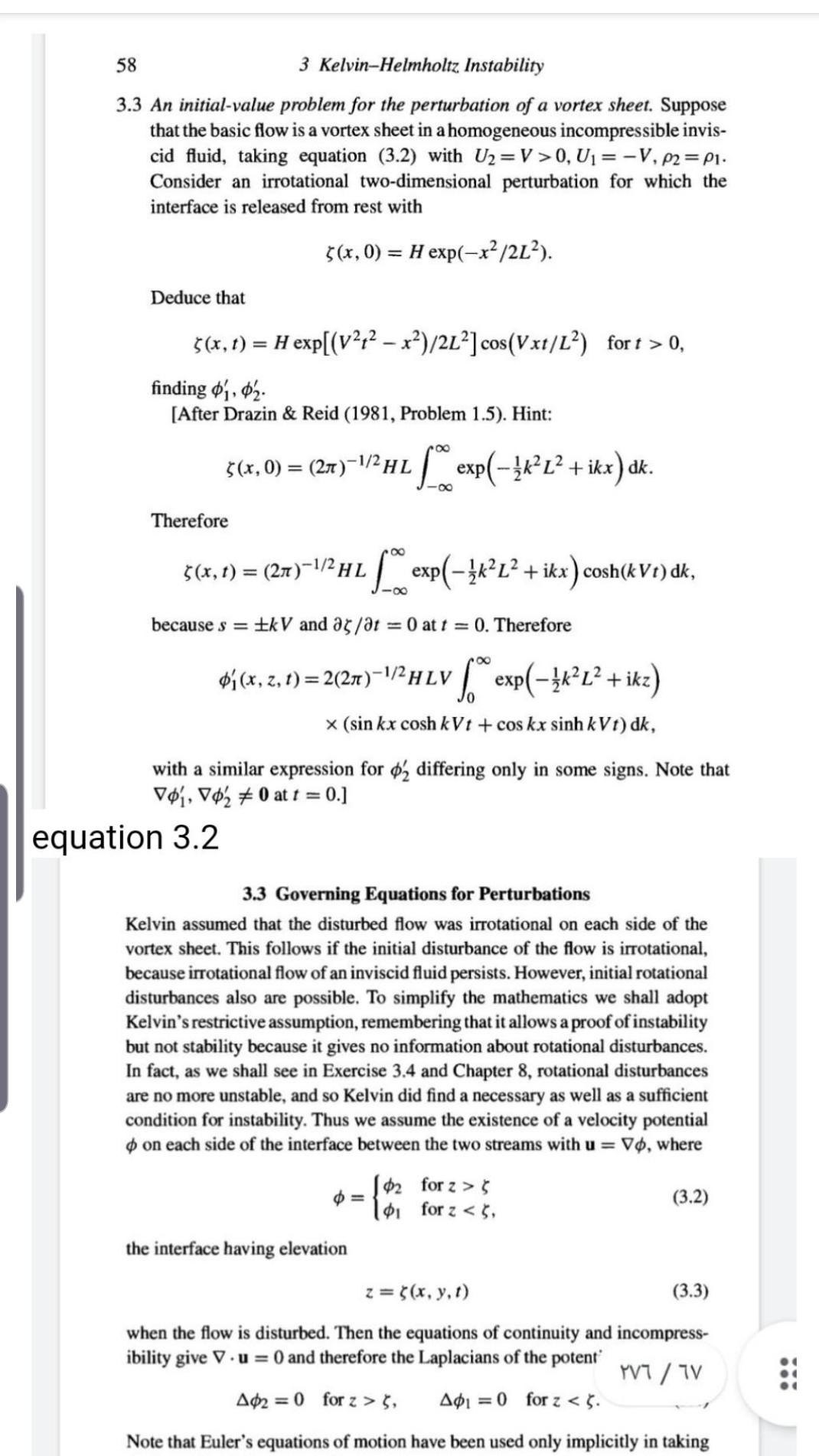
58 3 Kelvin-Helmholtz Instability 3.3 An initial-value problem for the perturbation of a vortex sheet. Suppose that the basic flow is a vortex sheet in a homogeneous incompressible invis- cid fluid, taking equation (3.2) with U2=V>0, U1 = -V, P2 = pi. Consider an irrotational two-dimensional perturbation for which the interface is released from rest with 5(x,0) = H exp(-x</212). Deduce that 5(x, t) = H exp[(v272 – xº)/224] cos(Vxt/L2) for t > 0, finding 01, 02. [After Drazin & Reid (1981, Problem 1.5). Hint: $(x, 0) = (21)-12 +1 | *exp(-_k?22 + ikx) dk. . Therefore 5(x, t) = (21)-1/2 HL exp(-žk?L? + ikx) cosh(kV1)dk, because s = EkV and as/at = 0 at t = 0. Therefore $1(x,z,t)=2(251)-1/2HLV $. * exp(-{x?2? +ik2) X (sin kx cosh kVt + cos kx sinh kVt) dk, with a similar expression for a differing only in some signs. Note that V¢1, V¢2 0 at t = 0.] equation 3.2 3.3 Governing Equations for Perturbations Kelvin assumed that the disturbed flow was irrotational on each side of the vortex sheet. This follows if the initial disturbance of the flow is irrotational, because irrotational flow of an inviscid fluid persists. However, initial rotational disturbances also are possible. To simplify the mathematics we shall adopt Kelvin's restrictive assumption, remembering that it allows a proof of instability but not stability because it gives no information about rotational disturbances. In fact, as we shall see in Exercise 3.4 and Chapter 8, rotational disturbances are no more unstable, and so Kelvin did find a necessary as well as a sufficient condition for instability. Thus we assume the existence of a velocity potential on each side of the interface between the two streams with u = V0, where (3.2) | 02 for z > 5 φ = loi for z <5, the interface having elevation z = 5(x, y, 1) (3.3) when the flow is disturbed. Then the equations of continuity and incompress- ibility give 7. u = 0 and therefore the Laplacians of the potent ۲۷۹ / ۹۷ Ap2 = 0 for z > 5, Api = 0 for z <5. Note that Euler's equations of motion have been used only implicitly in taking