- Problem Set 1 Mechanics Heat Review 1 Kinematics Kickoff During Kickoff For The Oakland Raiders Sebastian Janikows 1 (425.14 KiB) Viewed 40 times
- Problem Set 1 Mechanics Heat Review 1 Kinematics Kickoff During Kickoff For The Oakland Raiders Sebastian Janikows 2 (387.46 KiB) Viewed 40 times
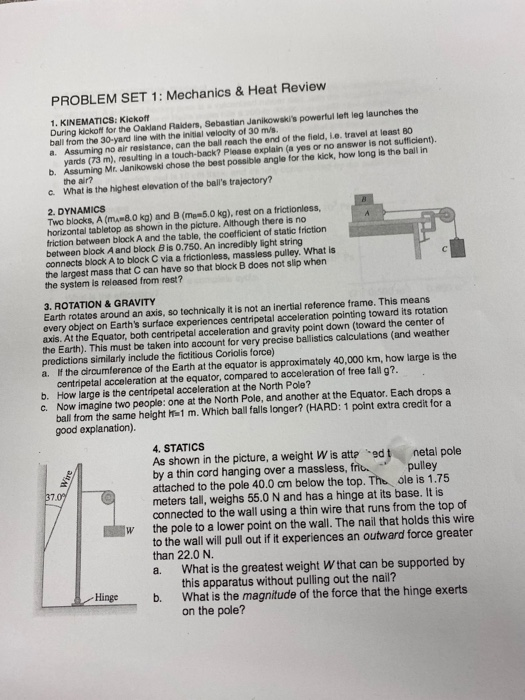
PROBLEM SET 1: Mechanics & Heat Review 1. KINEMATICS: Kickoff During kickoff for the Oakland Raiders, Sebastian Janikowski's powerful left leg launches the ball from the 30-yard line with the initial velocity of 30 m/s. a. Assuming no air resistance, can the ball reach the end of the field. Le travel at least 80 yards (73 m), resulting in a touch-back? Please explain (a yes or no answer is not sufficient). b. Assuming Mr. Janikow chose the best possible angle for the kick, how long is the ball in the air? c. What is the highest elevation of the ball's trajectory? 2. DYNAMICS Two blocks, A (maw8.0 kg) and B (m .0 kg), rest on a frictionless, horizontal tabletop as shown in the picture. Although there is no friction between block A and the table, the coefficient of static friction between block A and block Bis 0.750. An incredibly light string connects block A to block C via a frictionless, massless pulley. What is the largest mass that can have so that block B does not slip when the system is released from rest? 3. ROTATION & GRAVITY Earth rotates around an axis, so technically it is not an inertial reference frame. This means every object on Earth's surface experiences centripetal acceleration pointing toward its rotation axis. At the Equator, both centripetal acceleration and gravity point down (toward the center of the Earth). This must be taken into account for very precise ballistics calculations (and weather predictions similarly include the fictitious Coriolis force) a. If the circumference of the Earth at the equator is approximately 40,000 km, how large is the centripetal acceleration at the equator, compared to acceleration of free fallg?. b. How large is the centripetal acceleration at the North Pole? c. Now Imagine two people: one at the North Pole, and another at the Equator. Each drops a ball from the same height om. Which ball falls longor? (HARD: 1 point extra credit for a good explanation). 4. STATICS As shown in the picture, a weight W is attaedt netal pole by a thin cord hanging over a massless, frius pulley attached to the pole 40.0 cm below the top. The ole is 1.75 meters tall, weighs 55.0 N and has a hinge at its base. It is connected to the wall using a thin wire that runs from the top of the pole to a lower point on the wall. The nail that holds this wire to the wall will pull out if it experiences an outward force greater than 22.0 N. a. What is the greatest weight W that can be supported by this apparatus without pulling out the nail? b. b. What is the magnitude of the force that the hinge exerts on the pole? Hinge
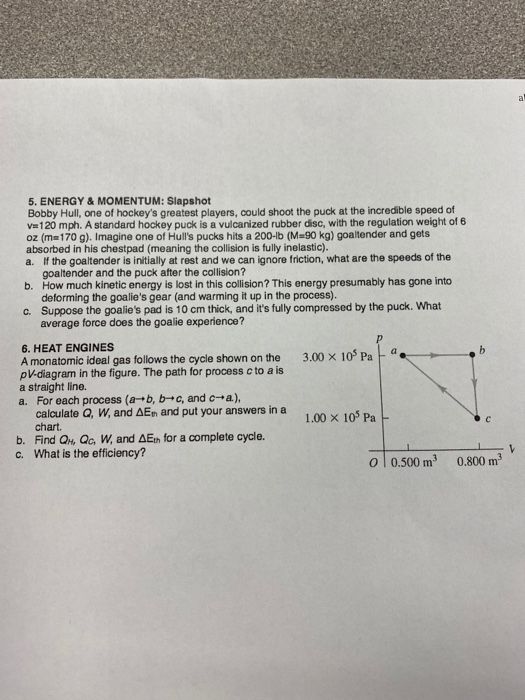
5. ENERGY & MOMENTUM: Slapshot Bobby Hull, one of hockey's greatest players, could shoot the puck at the incredible speed of Vw 120 mph. A standard hockey puck is a vulcanized rubber disc, with the regulation weight of 6 oz (m=170 9). Imagine one of Hull's pucks hits a 200-lb (M-90 kg) goaltender and gets absorbed in his chestpad (meaning the collision is fully inelastic). a. If the goaltender is initially at rest and we can ignore friction, what are the speeds of the goaltender and the puck after the collision? b. How much kinetic energy is lost in this collision? This energy presumably has gone into deforming the goalie's gear (and warming it up in the process). C. Suppose the goalie's pad is 10 cm thick, and it's fully compressed by the puck. What average force does the goalie experience? 3,00 X 10⁵ Pa a 6. HEAT ENGINES A monatomic ideal gas follows the cycle shown on the pV-diagram in the figure. The path for process cto a is a straight line. a. For each process (a--, --c, and c-a), calculate Q, W. and AEn and put your answers in a chart. b. Find Q, Qc W, and AEin for a complete cycle. c. What is the efficiency? 1.00 x 10 Pa o 10.500 m3 0.800 m