Page 1 of 1
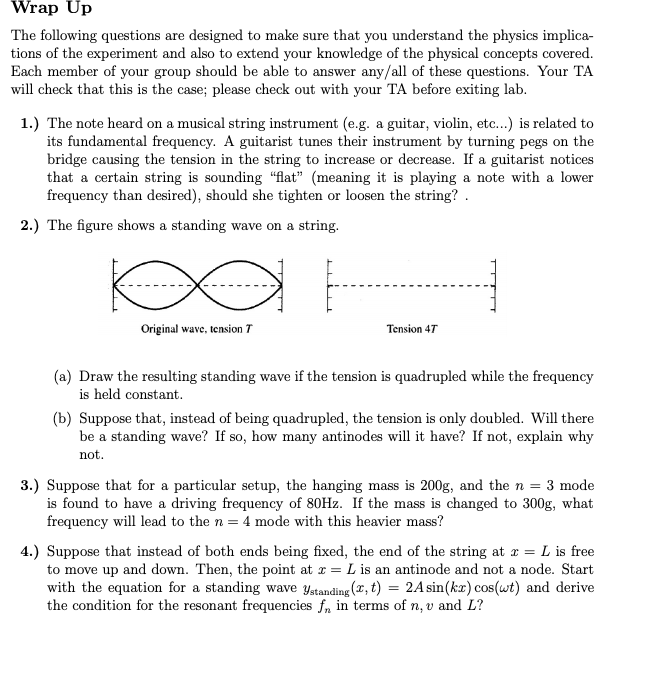
Wrap Up The following questions are designed to make sure that you understand the physics implica- tions of the experime
Posted: Mon Jul 18, 2022 6:04 am
by answerhappygod
- Wrap Up The Following Questions Are Designed To Make Sure That You Understand The Physics Implica Tions Of The Experime 1 (98.28 KiB) Viewed 39 times
Wrap Up The following questions are designed to make sure that you understand the physics implica- tions of the experiment and also to extend your knowledge of the physical concepts covered. Each member of your group should be able to answer any/all of these questions. Your TA will check that this is the case; please check out with your TA before exiting lab. 1.) The note heard on a musical string instrument (e.g. a guitar, violin, etc...) is related to its fundamental frequency. A guitarist tunes their instrument by turning pegs on the bridge causing the tension in the string to increase or decrease. If a guitarist notices that a certain string is sounding "flat" (meaning it is playing a note with a lower frequency than desired), should she tighten or loosen the string? . 2.) The figure shows a standing wave on a string. Original wave, tension T Tension 47 (a) Draw the resulting standing wave if the tension is quadrupled while the frequency is held constant. (b) Suppose that, instead of being quadrupled, the tension is only doubled. Will there be a standing wave? If so, how many antinodes will it have? If not, explain why not. 3.) Suppose that for a particular setup, the hanging mass is 200g, and the n = 3 mode is found to have a driving frequency of 80Hz. If the mass is changed to 300g, what frequency will lead to the n = 4 mode with this heavier mass? 4.) Suppose that instead of both ends being fixed, the end of the string at x = L is free to move up and down. Then, the point at = L is an antinode and not a node. Start with the equation for a standing wave Ystanding (2, t) = 2A sin(kx) cos(wt) and derive the condition for the resonant frequencies fn in terms of n, v and L?